
A permit form is not the same as a controlled authorization system. High-risk operations may need validated approval sequencing, isolation management, permit expiry and simultaneous-operations controls. Choose a product against those safety requirements before comparing template libraries or subscription prices.
How to use this shortlist: VelocityEHS publishes an electronic permit-to-work offering. General EHS and inspection platforms require a demonstration of the exact permit controls. BasinCheck belongs on a documentation shortlist when configurable forms and supporting field records meet the approved process. Verify enforcement controls and approved fallback procedures. Saving a form offline does not authorize work to begin.
Publisher disclosure: BasinCheck publishes this comparison and sells one of the products. List order is editorial, not a test score or an independent award. Sources are linked in each product section; the current product names and plan limits matter more than a blanket feature checklist.
| # | Product | Best for | Pricing |
|---|---|---|---|
| 1 | BasinCheck | Oilfield and industrial teams adapting field safety workflows | Company-based plans with unlimited users; monthly field-record limits apply. See current pricing. |
| 2 | Ideagen EHS (formerly Lucidity) | Organizations standardizing health and safety workflows and risk reporting | See vendor pricing; request a quote for the required scope |
| 3 | Mitti (by SafetyCulture; formerly iAuditor) | Teams combining inspections, training and operational reporting | Free plan up to 10 seats and 5 active templates; Premium $24/seat/mo annually or $29 monthly, excluding taxes. |
| 4 | VelocityEHS | Organizations needing safety plus chemical, ergonomics or operational risk tools | See vendor pricing; request a quote for the required scope |
| 5 | Intelex | Organizations choosing between a focused safety package and broader EHSQ | See vendor pricing; request a quote for the required scope |
| 6 | Evotix | Organizations combining safety with occupational health and environmental management | See vendor pricing; request a quote for the required scope |
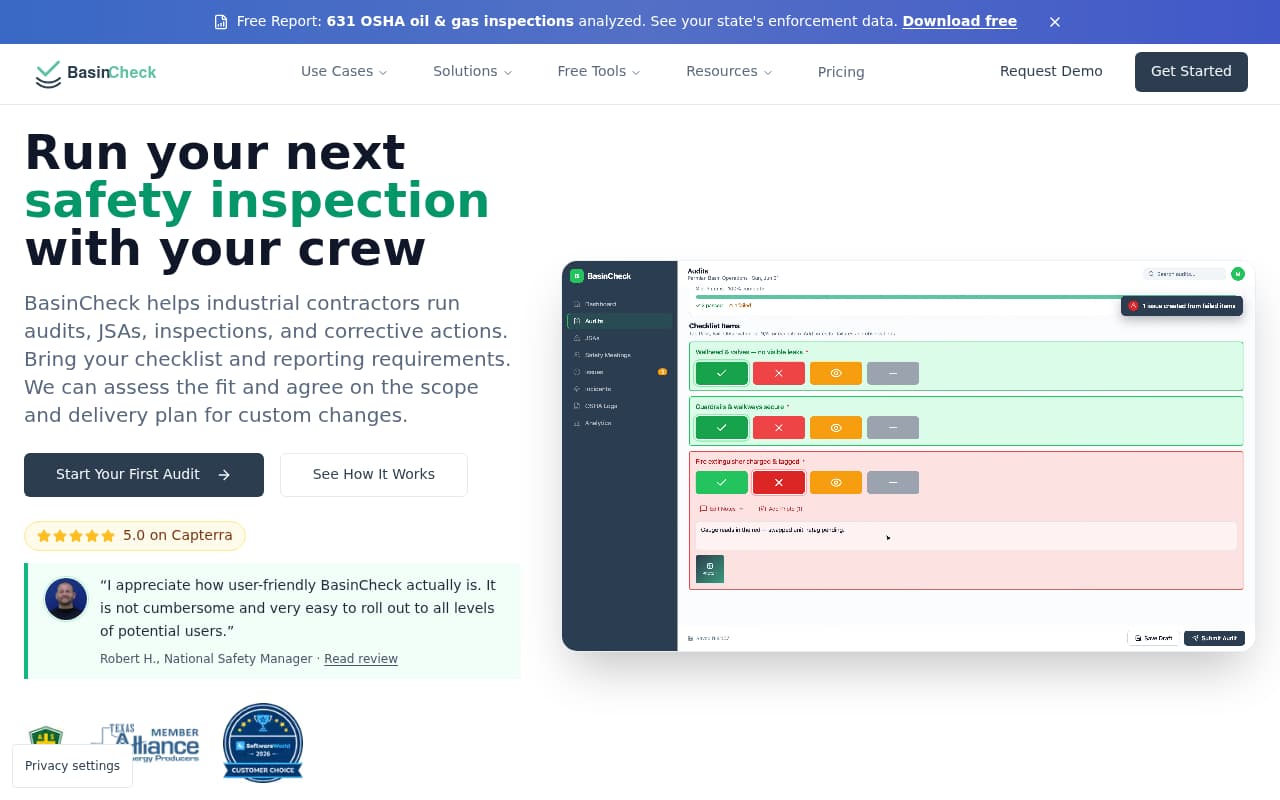
BasinCheck
Oilfield and industrial teams adapting field safety workflows
Best For
Oilfield and industrial teams adapting field safety workflows
Pricing
Company-based plans with unlimited users; monthly field-record limits apply. See current pricing.
BasinCheck is presented here as a configurable field safety and permit documentation option. This review does not establish a complete isolation management, SIMOPS conflict or enforced authorization system. Choose a specialist control-of-work product when those controls are required.
Vendor sources checked October 7, 2026: Product overview; Plans and record limits.
Key Features
Pros
- Templates can be adapted to your field safety process
- Company-based licensing allows access for the whole crew
Limitations and checks
- Focused field safety system; not a full EHS suite. Agree the scope, cost and acceptance criteria for custom work.
Verdict: Shortlist BasinCheck when focused field safety and agreed customization needs match the brief. Verify the complete workflow in a pilot.
Ideagen EHS (formerly Lucidity)
Organizations standardizing health and safety workflows and risk reporting
Best For
Organizations standardizing health and safety workflows and risk reporting
Pricing
See vendor pricing; request a quote for the required scope
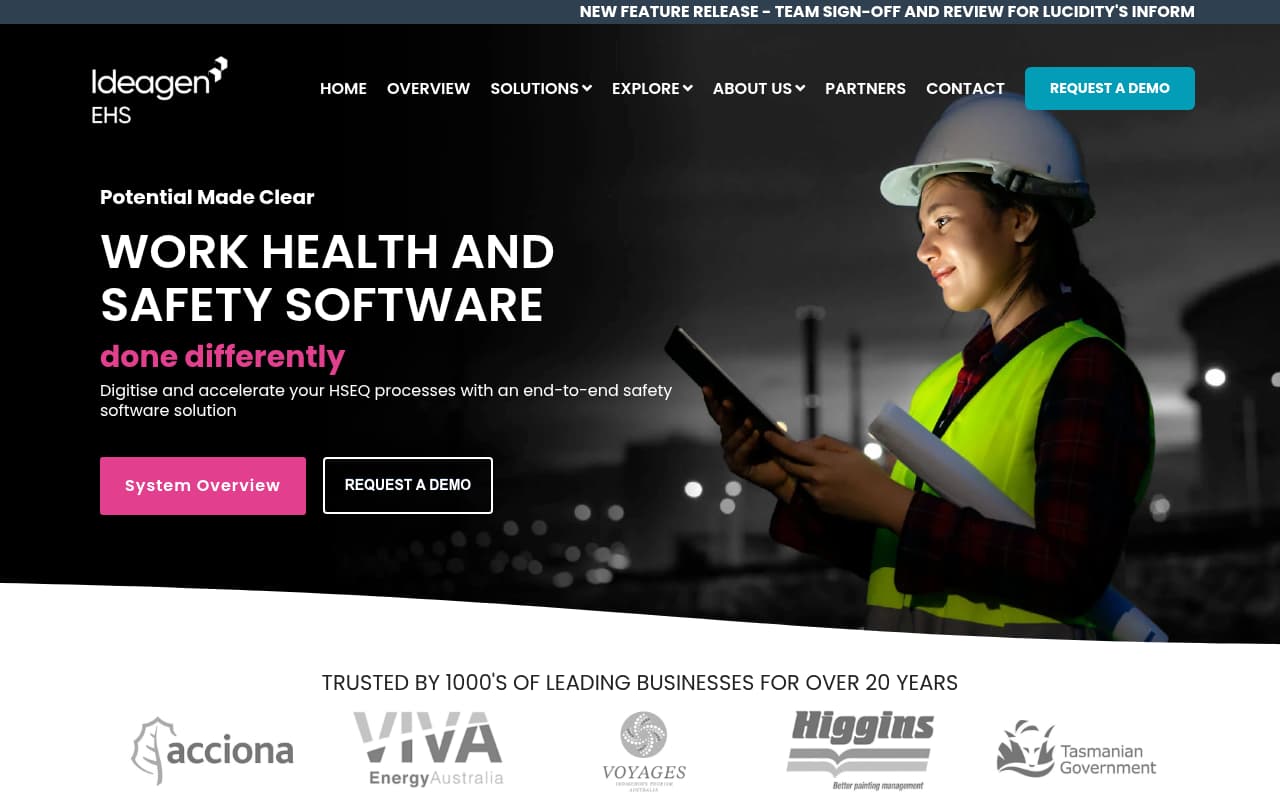
Ideagen EHS (formerly Lucidity) is a candidate for organizations standardizing health and safety workflows and risk reporting. Its published capabilities include health and safety data collection, risk assessments and registers, configurable dashboards.
Vendor sources checked October 7, 2026: Current Ideagen name and documented EHS scope.
Key Features
Pros
- Health and safety data collection
- Risk assessments and registers
Limitations and checks
- The reviewed public overview does not substantiate this article’s former claims about automatic permit conflict detection or isolation certificates. Require a demonstration before treating it as a dedicated control-of-work system.
Verdict: Shortlist for organizations standardizing health and safety workflows and risk reporting.
Mitti (by SafetyCulture; formerly iAuditor)
Teams combining inspections, training and operational reporting
Best For
Teams combining inspections, training and operational reporting
Pricing
Free plan up to 10 seats and 5 active templates; Premium $24/seat/mo annually or $29 monthly, excluding taxes.
Mitti (by SafetyCulture; formerly iAuditor) is a candidate for teams combining inspections, training and operational reporting. Its published capabilities include configurable inspection templates, mobile inspections with offline support, tasks and issue reporting.
Vendor sources checked October 7, 2026: SafetyCulture platform name change; Plans and pricing; Scheduled inspections and offline conditions.
Key Features
Pros
- Configurable inspection templates
- Mobile inspections with offline support
Limitations and checks
- Free plan has seat/template limits. Validate the required approval, investigation and OSHA export workflow on the chosen plan.
Verdict: Shortlist for teams combining inspections, training and operational reporting.
Try BasinCheck Free for 7 Days
Check BasinCheck plan limits and pricing against your requirements.
Start Free TrialVelocityEHS
Organizations needing safety plus chemical, ergonomics or operational risk tools
Best For
Organizations needing safety plus chemical, ergonomics or operational risk tools
Pricing
See vendor pricing; request a quote for the required scope
VelocityEHS is a candidate for organizations needing safety plus chemical, ergonomics or operational risk tools. Its published capabilities include incident and audit management, job safety analysis, chemical and industrial hygiene applications.
Vendor sources checked October 7, 2026: Solution portfolio; Electronic permit to work.
Key Features
Pros
- Incident and audit management
- Job safety analysis
Limitations and checks
- Select the required solutions and validate licensing, mobile/offline scope and permit authorization controls in a demonstration.
Verdict: Shortlist for organizations needing safety plus chemical, ergonomics or operational risk tools.
Intelex
Organizations choosing between a focused safety package and broader EHSQ

Best For
Organizations choosing between a focused safety package and broader EHSQ
Pricing
See vendor pricing; request a quote for the required scope
Intelex is a candidate for organizations choosing between a focused safety package and broader EHSQ. Its published capabilities include inspections and audits, incident management, corrective action plans.
Vendor sources checked October 7, 2026: Safety Essentials scope and guided deployment; Application portfolio; Mobile and offline inspections.
Key Features
Pros
- Inspections and audits
- Incident management
Limitations and checks
- Essentials is a distinct, preconfigured option for growing teams. Compare its included applications with the wider suite; do not assume every rollout requires months.
Verdict: Shortlist for organizations choosing between a focused safety package and broader EHSQ.
Evotix
Organizations combining safety with occupational health and environmental management
Best For
Organizations combining safety with occupational health and environmental management
Pricing
See vendor pricing; request a quote for the required scope
Evotix is a candidate for organizations combining safety with occupational health and environmental management. Its published capabilities include incident management, audits and inspections, contractor safety management.
Vendor sources checked October 7, 2026: Current EHS and ESG portfolio.
Key Features
Pros
- Incident management
- Audits and inspections
Limitations and checks
- Select the required modules and confirm permit, isolation and offline behavior. Product breadth does not prove that every high-risk authorization requirement is included.
Verdict: Shortlist for organizations combining safety with occupational health and environmental management.
Side-by-side feature comparison
Scroll horizontally to compare every column. Capabilities are vendor-documented; confirm the selected plan in a pilot.
| Software | Best For | Starting Price | Published Scope | Check Before Buying |
|---|---|---|---|---|
| BasinCheck | Oilfield and industrial teams adapting field safety workflows | Company-based plans with unlimited users; monthly field-record limits apply. See current pricing. | Configurable audit and inspection templates; Corrective actions with owners and follow-up | Focused field safety system; not a full EHS suite. Agree the scope, cost and acceptance criteria for custom work. |
| Ideagen EHS (formerly Lucidity) | Organizations standardizing health and safety workflows and risk reporting | See vendor pricing; request a quote for the required scope | Health and safety data collection; Risk assessments and registers | The reviewed public overview does not substantiate this article’s former claims about automatic permit conflict detection or isolation certificates. Require a demonstration before treating it as a dedicated control-of-work system. |
| Mitti (by SafetyCulture; formerly iAuditor) | Teams combining inspections, training and operational reporting | Free plan up to 10 seats and 5 active templates; Premium $24/seat/mo annually or $29 monthly, excluding taxes. | Configurable inspection templates; Mobile inspections with offline support | Free plan has seat/template limits. Validate the required approval, investigation and OSHA export workflow on the chosen plan. |
| VelocityEHS | Organizations needing safety plus chemical, ergonomics or operational risk tools | See vendor pricing; request a quote for the required scope | Incident and audit management; Job safety analysis | Select the required solutions and validate licensing, mobile/offline scope and permit authorization controls in a demonstration. |
| Intelex | Organizations choosing between a focused safety package and broader EHSQ | See vendor pricing; request a quote for the required scope | Inspections and audits; Incident management | Essentials is a distinct, preconfigured option for growing teams. Compare its included applications with the wider suite; do not assume every rollout requires months. |
| Evotix | Organizations combining safety with occupational health and environmental management | See vendor pricing; request a quote for the required scope | Incident management; Audits and inspections | Select the required modules and confirm permit, isolation and offline behavior. Product breadth does not prove that every high-risk authorization requirement is included. |
How we evaluated these tools
We reviewed official public product pages, help documentation and published pricing on October 7, 2026. Links appear in each product section. We did not conduct a controlled, side-by-side product trial, survey customers or verify vendor performance claims. Published support is described as documented capability; unverified details are buying questions rather than claims that a competitor lacks a feature.
Criteria for this comparison: Verify enforcement controls and approved fallback procedures. Saving a form offline does not authorize work to begin.
- Demonstrate your approved permit process, including authorization, required tests, suspension, handover and closure. Test how conflicting or incomplete work is prevented.
- Use the same sample record, device and required output with each shortlisted vendor.
- Separate included features from paid modules, minimum seats, integrations and services.
- Ask who can change a template or workflow, and agree cost, delivery target and acceptance criteria for custom work.
- Record the pilot result before deciding. No vendor, including BasinCheck, earns a deployment-speed or usability advantage from its marketing page alone.
BasinCheck is best considered for faster-moving field teams that value focused safety workflows and access to customization discussions. This is a fit recommendation, not evidence that competitors cannot customize or that BasinCheck implements every change faster. See our editorial policy.
Frequently Asked Questions
How do we choose permit-to-work software and permit documentation tools?
Verify enforcement controls and approved fallback procedures. Saving a form offline does not authorize work to begin. VelocityEHS publishes an electronic permit-to-work offering. General EHS and inspection platforms require a demonstration of the exact permit controls. BasinCheck belongs on a documentation shortlist when configurable forms and supporting field records meet the approved process.
Is a permit template equivalent to permit-to-work software?
No. A template records information. A control-of-work system may enforce authorization, isolation, permit validity and coordination between simultaneous jobs. Require the vendor to demonstrate each control against your approved process before using it for high-risk authorization.
How should we compare price and customization costs?
Request the same scope from each vendor: users and roles, sites, monthly records, required modules, integrations and support. Include seat minimums and annual commitments. Ask which template changes are self-service and which customizations require an agreed scope, cost, delivery target and acceptance test.
Were these products tested side by side?
No. This is a comparison published by BasinCheck using official public product and pricing documentation checked on October 7, 2026. Product capabilities are vendor-documented, not a comparative usability or performance benchmark. The evaluation tasks are recommendations for your own pilot.
Final verdict
VelocityEHS publishes an electronic permit-to-work offering. General EHS and inspection platforms require a demonstration of the exact permit controls. BasinCheck belongs on a documentation shortlist when configurable forms and supporting field records meet the approved process.
BasinCheck is presented here as a configurable field safety and permit documentation option. This review does not establish a complete isolation management, SIMOPS conflict or enforced authorization system. Choose a specialist control-of-work product when those controls are required. Teams that need quick changes should use the pilot to agree a concrete template or workflow change, a delivery target and an acceptance test. We have not established a comparative deployment-time advantage.
Bring one real workflow to a BasinCheck demonstration, review the current plans and field-record limits, and compare the same requirements with the other vendors on your shortlist.