Free Job Safety Analysis (JSA) Template — Word, PDF & Excel
Free job safety analysis template for oilfield and construction. Printable JSA/JHA form with hazard ID, risk controls, PPE. Download in Word, PDF, Excel.
Get all 3 formats — Word, PDF & Excel — delivered to your inbox instantly.
Your free JSA template downloads right away in Word, PDF, or Excel. We'll share hazard identification tips, then won't bother you again unless you subscribe.
Before you open that Word doc...
Word/PDF Template
- ❌ Manual version control
- ❌ Lost in email chains
- ❌ No photo attachments
- ❌ Can't sign on mobile
BasinCheck Digital JSA
- ✅ Auto-syncs to dashboard
- ✅ Built-in hazard library
- ✅ Photo documentation
- ✅ Crew sign-off on any phone

Created by Jacob Szyszka, founder of BasinCheck · ASSP member · built with safety managers in the Permian Basin
Industry membership and independent recognition

 Energy producer network member
 SoftwareWorldCustomer Choice recognition
What's Included in This Checklist
Template Downloaded. What's Next?
Use the Template
- ✓ Print and fill out by hand
- ✓ Scan and email to office
- ✓ File in binder for audits
Works for low-volume operations
Go Digital
Recommended- ✓ Hazard library suggests controls
- ✓ Crew signs on their phones
- ✓ Syncs to compliance dashboard
- ✓ Searchable audit history
50% off — $149/mo · only 9 founding seats left
Start Free Trial — $149/moWhy JSA Templates Matter in Oil & Gas
Job Safety Analysis (JSA), also called Job Hazard Analysis (JHA), is the foundation of proactive safety management in oilfield and construction operations. By systematically breaking down each task into steps and identifying potential hazards before work begins, crews can implement controls that prevent incidents rather than reacting to them. Studies show that organizations with robust JSA programs experience up to 50% fewer recordable incidents. Whether you need a free JSA template for construction or oilfield work, this JSA form template transforms safety from reactive paperwork into active prevention.
"Checklists are easy. Closeouts and accountability are where teams still struggle."
- Safety manager, oilfield contractor (anonymized from industry research)
Tired of Paper JSAs? Try Our Free Online Builder
Build JSAs interactively, add hazards and controls, and download a professional PDF — no signup required.
Try Free JSA BuilderKey Inspection Areas Covered
Task Breakdown and Sequencing
Divide the job into individual steps in the order they will be performed. Each step should describe a single action. Involve the crew members who will actually perform the work to ensure accuracy and buy-in. Document any deviations from standard operating procedures.
Hazard Identification by Step
For each task step, identify all potential hazards including struck-by, caught-between, falls, electrical, chemical exposure, ergonomic strain, and environmental conditions. Consider hazards from adjacent operations, changing conditions, and equipment interactions. Ask "what could go wrong?" for each step.
Risk Assessment and Prioritization
Evaluate each hazard for probability of occurrence and potential severity of consequences. Use a risk matrix to prioritize hazards requiring the most robust controls. High-probability, high-severity hazards require engineering controls or elimination; lower risks may be addressed with administrative controls and PPE.
Control Measures Selection
Apply the hierarchy of controls: elimination, substitution, engineering controls, administrative controls, and PPE (in order of effectiveness). Document specific control measures for each identified hazard. Ensure controls are practical, available, and understood by all crew members.
Crew Review and Sign-Off
Review the completed JSA with all crew members before work begins. Ensure every person understands the hazards and controls specific to their role. Obtain signatures acknowledging understanding and commitment. Emphasize stop-work authority if conditions change or new hazards emerge.
Regulatory Requirements & Compliance
While OSHA does not mandate a specific JSA format, the General Duty Clause (Section 5(a)(1)) requires employers to provide workplaces free from recognized hazards. OSHA strongly recommends JSA as a best practice for hazard identification in both construction and oil and gas industries. API RP 75 for offshore safety management and API RP 54 for onshore drilling operations both emphasize pre-job hazard analysis (JHA) as essential elements of safety programs. Many operators require free printable JSA forms for all non-routine work as a contractual condition.
Why Safety Teams Trust This Template
OSHA JHA Best Practice
Follows OSHA-recommended Job Hazard Analysis (JHA) methodology with hierarchy of controls framework.
Free Download in 3 Formats
Get your free JSA template download in Word, PDF, or Excel. Printable JSA forms ready for immediate use.
Oilfield & Construction Ready
Used by safety supervisors across oilfield operations and construction sites. JSA construction template included.
Common Questions About JSA Templates
When should a new JSA form be developed versus using an existing one?
Develop a new JSA for any non-routine task in oilfield or construction work, when conditions differ significantly from previous work, when new equipment or materials are introduced, or after an incident reveals gaps in existing analysis. Use your free JSA template for routine tasks but review and update at least annually. The crew should always review the JSA sheets before starting work.
Who should participate in developing a Job Hazard Analysis (JHA)?
The most effective JSAs and JHAs are developed collaboratively by the supervisor and the crew members who will perform the work. Front-line workers in oilfield and construction bring practical knowledge of actual conditions and potential hazards. Safety professionals can provide expertise on control measures. This participative approach improves both the quality of the Job Safety Analysis and crew buy-in.
How detailed should each step in a JSA be?
Each step should describe a single action that creates potential for a specific hazard. If a step is too broad (e.g., "assemble equipment"), important hazards may be overlooked. If steps are too granular (e.g., "pick up wrench, turn wrench clockwise"), the document becomes unwieldy. A typical JSA has 8-15 steps. Focus on steps where hazards exist rather than documenting every minor action.
Is a JHA form the same as a JSA form?
Yes. A JHA form (job hazard analysis form) and a JSA form are the same document under two names - OSHA uses "job hazard analysis" while oil and gas operators typically say "job safety analysis." The standard JHA format is identical: job steps in the first column, potential hazards in the second, and controls in the third, plus header fields for location, date, crew, and PPE. This template works as either a JSA or a JHA form, and the Word download is fully editable if your client requires their own JHA format.
About This Free Download
Is this JSA template really free to download?
Yes, this is a completely free JSA template. Enter your email and get the free printable JSA form immediately in Word, PDF, or Excel.
Can I use this free JHA template for construction?
Absolutely. This JSA construction template works for both oilfield and construction jobs. The free JHA template Word format is fully editable for your specific needs.
What does this free JSA form template include?
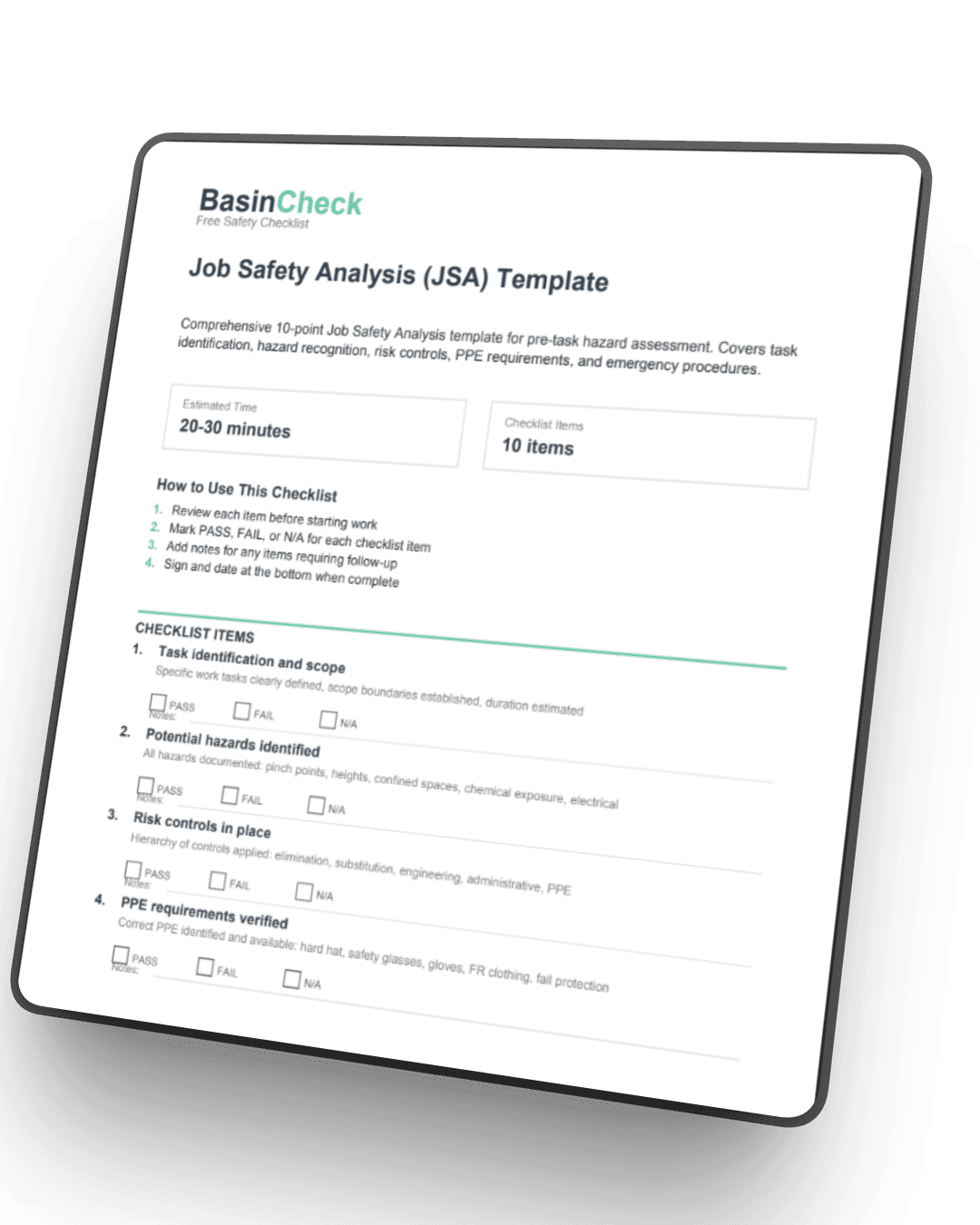
This JSA form template covers 10 sections: task breakdown, hazard identification, risk assessment, control selection, and crew acknowledgment. Use our printable JSA sheets for thorough 20-30 minute job safety analysis.
Your JSA template is a start. BasinCheck is the system.
Create JSAs in 2 minutes with our hazard library. Crews sign off on their phones. Every JSA syncs to your compliance dashboard automatically. No more chasing paper before an audit. Founding customer pricing: 50% off — only 9 seats left.
More Free Safety Checklists
Want All 6 Templates Including This JSA Template?
Combine JSA with rig inspection, hot work, confined space, equipment, and toolbox talk templates - everything you need for a complete safety program.
Get Complete KitGet Your Free JSA Template
Your free JSA template downloads right away in Word, PDF, or Excel. We'll share hazard identification tips, then won't bother you again unless you subscribe.