Software Reviews
KPA EHS Software: An Honest Review for Oil & Gas Contractors
You've heard the name, but you can't get a straight answer. Is the KPA EHS platform genuinely built for the high-stakes environment of oil and gas, or is it another complex corporate tool that will slow your crews down in the field?
Generalist software often fails to understand our industry's specific compliance risks, from rig inspections to JSAs. You need to know if it's a tool your team will actually use and if the investment is worth it - before committing to a lengthy sales demo.
This review delivers the critical information you're missing. For a broader perspective on selecting the right platform, see our H&S software buyer's guide. We provide an honest, no-nonsense breakdown of KPA EHS features, real-world pros and cons for contractors, and a clear-eyed look at how it compares to purpose-built, field-ready alternatives. Our goal is to give you the data needed to decide if this platform will truly make your operations more efficient and audit-ready, or if it will create more problems than it solves.
What is KPA EHS? An Overview of the All-in-One Platform
KPA EHS is a comprehensive software platform designed to manage a company's safety and compliance programs. Its primary objective is to centralize key aspects of a company's Environmental, Health, and Safety (EHS) program, aiming to replace the disjointed system of spreadsheets, paper forms, and separate training portals that many businesses struggle with. Unlike purpose-built tools designed for the unique demands of a single high-risk industry, KPA takes a broad approach, offering a generalist solution intended to serve a wide range of business types.
The following video from KPA provides a basic look at how forms are built within their system:
Who is KPA EHS Software For?
The platform is built for companies that require a wide-ranging, rather than a deeply specialized, safety solution. It finds its primary user base in sectors like automotive dealerships, manufacturing, and general construction. The KPA EHS system is often a fit for mid-to-large size organizations that have dedicated, multi-person EHS departments. Its appeal lies with companies managing varied, but often standardized, risks across different business units where a "one-size-fits-most" approach is sufficient to meet their compliance needs.
Core Components of the KPA Platform
The KPA offering is structured around three main pillars, designed to work together to create a complete safety and compliance ecosystem. The goal is to provide a single point of control for EHS managers to oversee risk, training, and regulatory adherence.
- EHS Software: This is the digital hub for managing safety programs. It includes modules for conducting inspections, tracking incidents and near-misses, managing corrective actions, and maintaining critical compliance documentation like Safety Data Sheet (SDS) binders and audit trails.
- Online Training: The platform includes a large library of pre-built training courses covering general topics from HR compliance to OSHA safety standards. This content can be assigned to employees and tracked within the system to ensure workforce completion.
- Consulting Services: For an additional layer of support, KPA offers access to EHS experts who can provide guidance, conduct on-site audits, and assist in developing or refining corporate safety policies.
A Deep Dive into KPA EHS Software Features
KPA EHS positions itself as a comprehensive, all-in-one platform for managing environmental, health, and safety programs. It serves a wide range of industries, from automotive to construction. To determine its suitability for the high-stakes oil and gas sector, we must analyze how its generalist features translate to the specific demands of the oilfield.
Form Building and Inspection Management
The software includes a flexible form builder, allowing safety managers to create custom digital forms for audits, checklists, and observations. This means you can build your own Job Safety Analysis (JSA), Job Hazard Analysis (JHA), or vehicle inspection forms from scratch, tailoring fields and logic to your internal processes.
Consideration for Oil & Gas: A flexible builder offers control, but it also requires significant setup time. The critical question is whether this flexibility is more valuable than having access to a library of pre-built, field-tested forms designed specifically for oilfield tasks like rig inspections or BOP checks.
Mobile App and Field Usability
A core component of the KPA EHS platform is its mobile application, designed to empower field workers to capture safety data directly from the job site. The app is intended to replace paper forms, allowing for real-time submission of inspections, incident reports, and safety observations from any mobile device.
Consideration for Oil & Gas: Field operations frequently occur in remote locations with unreliable or non-existent cell service. The effectiveness of any mobile EHS tool hinges on its offline capabilities. How seamlessly does the app sync data once a connection is re-established, and can a supervisor complete and sign off on a JSA for their crew entirely offline?
Reporting, Dashboards, and Analytics
KPA provides dashboards and reporting tools to help management track safety performance. These visuals help monitor leading indicators (like safety observations and training completion) and lagging indicators (like TRIR and DART rates). The goal is to provide a high-level view of organizational safety health and identify risk trends.
Consideration for Oil & Gas: While tracking standard EHS metrics is essential, oil and gas contractors must often report on specific operational risks and compliance standards demanded by major operators. The analytics must be granular enough to meet stringent requirements, such as those outlined in the IFC's EHS Guidelines for Oil and Gas, not just generic safety KPIs.
Incident Management and Corrective Actions
The platform features a structured workflow for incident management. It allows employees to report an incident or near-miss, which then triggers an investigation and assignment of Corrective and Preventive Actions (CAPAs). The system tracks each CAPA through to completion, creating a documented audit trail.
Consideration for Oil & Gas: In a fast-paced field environment, the speed of initial reporting is critical for preventing a near-miss from becoming a recordable incident. The process must be simple and fast enough for a field supervisor to log a near-miss in under a minute, without navigating complex menus or confusing forms.
Pros and Cons of KPA EHS for Oil & Gas Contractors
KPA EHS is a well-established and comprehensive software suite designed to serve a wide range of industries, from automotive dealerships to insurance. Its strength lies in its breadth, offering an all-in-one solution for corporate risk management. However, for oil and gas contractors, this "one-size-fits-all" approach presents a distinct set of trade-offs between corporate oversight and field-level usability.
To make an informed decision, it's critical to weigh the platform's enterprise-grade features against the day-to-day operational realities of the oilfield. What serves a corporate safety director in an office may not serve a field supervisor on a remote well site.
For large, diversified organizations, the KPA EHS platform offers significant advantages. Its reputation as a comprehensive EHS solution is reinforced by its inclusion in resources like the National Safety Council TechHub Marketplace.
- Integrated Platform: Combines safety, compliance, HR, and training into a single system, providing a unified source of data for corporate-level management.
- Extensive Training Library: Offers a vast library of pre-built training courses, reducing the burden on companies to create all their safety training content from scratch.
- High Configurability: Can be customized to accommodate complex corporate workflows, multi-layered approval processes, and unique business unit requirements.
- Strong Reporting: Powerful analytics and reporting tools designed to give executives high-level oversight of EHS performance across the entire organization.
While powerful, the platform's broad focus can create specific challenges for the fast-paced, rugged environment of oil and gas operations. Contractors should consider these potential drawbacks:
- Field Adoption Complexity: An enterprise system with numerous features and modules can be overwhelming for field crews. A steep learning curve often leads to poor adoption and a return to paper forms.
- Not Purpose-Built for Oil & Gas: Lacks native, ready-to-use forms for industry-specific tasks like rig inspections, BOP tests, or hot work permits. These must be built manually.
- Paying for Unneeded Modules: The all-in-one model may force contractors to pay for features irrelevant to their business, such as modules for automotive F&I compliance.
- Offline Functionality: Generalist platforms may not have offline capabilities as robust as those of a field-first app. Unreliable data syncing from remote locations can compromise data integrity.
| Pros (Corporate Strengths) | Cons (Field Challenges) |
|---|---|
| Single platform for all EHS, HR, and compliance needs. | Complexity can overwhelm field users and hinder adoption. |
| Large library of pre-built safety training content. | Lacks out-of-the-box forms for specific oilfield tasks (e.g., rig inspections). |
| Highly configurable for complex corporate workflows. | Subscription may include costly, irrelevant modules (e.g., F&I). |
| Powerful reporting for high-level executive oversight. | Offline functionality may not be as reliable as a purpose-built field app. |
KPA Pricing and Implementation: What to Expect
KPA does not publicly list its pricing. Like most comprehensive enterprise EHS platforms, the cost is customized based on your company's specific operational needs and scale. This requires engaging with their sales team for a formal quote to determine the final investment. Understanding the factors that drive this cost and the typical implementation process is critical for making an informed decision.
How KPA EHS is Priced
The KPA EHS platform generally follows a standard Software-as-a-Service (SaaS) model, which involves a recurring subscription fee, often billed annually. The final price is not a single number but a calculation based on several key variables:
- Company Size: The total number of employees or active users who will need access to the system is a primary cost driver.
- Modules Selected: KPA offers a wide range of modules for safety, compliance, and workforce management. Your cost will depend entirely on which specific solutions you need to license.
- Training and Support: The level of onboarding, administrator training, and ongoing technical support required will influence the overall package price.
It is also important to budget for potential one-time costs. These can include initial implementation fees for system configuration and data migration, as well as fees for specialized consulting services if required.
The Implementation Process
Deploying a large-scale EHS platform is a significant project, not a simple software installation. The process requires dedicated internal resources (typically a project lead) and can take anywhere from several weeks to multiple months, depending on your company's complexity and the modules you've chosen.
A successful rollout typically involves several distinct phases:
- Discovery & Scoping: KPA's team works with you to map your existing safety processes, compliance requirements, and reporting needs.
- Configuration: The software is tailored to match your specific workflows, digital forms (like JSAs or incident reports), and organizational structure.
- Data Migration: Your existing data - from employee records to historical training logs and safety documents - is imported into the new system.
- Training & Rollout: Administrators and end-users are trained on how to use the platform effectively, which is critical for field adoption and ROI.
For oil and gas contractors, this level of investment highlights the importance of choosing a solution that aligns with your operational tempo. An enterprise system requires a major commitment, whereas a purpose-built tool might offer a faster path to becoming audit-ready.
BasinCheck: The Purpose-Built Alternative to KPA EHS
The fundamental difference between BasinCheck and KPA EHS comes down to a simple choice: all-in-one versus purpose-built. While KPA offers a broad software suite designed to serve diverse corporations from automotive to insurance, this generalist approach creates significant friction for oil and gas contractors. Their workflows, compliance requirements, and field environments are unique and demand a specialized tool.
BasinCheck was engineered from the ground up to solve the specific safety documentation challenges of the oilfield. It is not a generic platform adapted for energy; it is a dedicated solution built for the people who work in it.
Why a Niche Focus Matters in the Oilfield
Oil and gas operations run on specific forms like JSAs, rig inspections, and vehicle checklists. These aren't just paperwork; they are critical risk management tools. Crews in the field need extreme simplicity and reliability. They don't have time to navigate complex corporate software. More importantly, work often happens on remote sites with no cell service, making true offline functionality a non-negotiable requirement for any usable safety app.
BasinCheck: Built for the Field, Not the Corporate Office
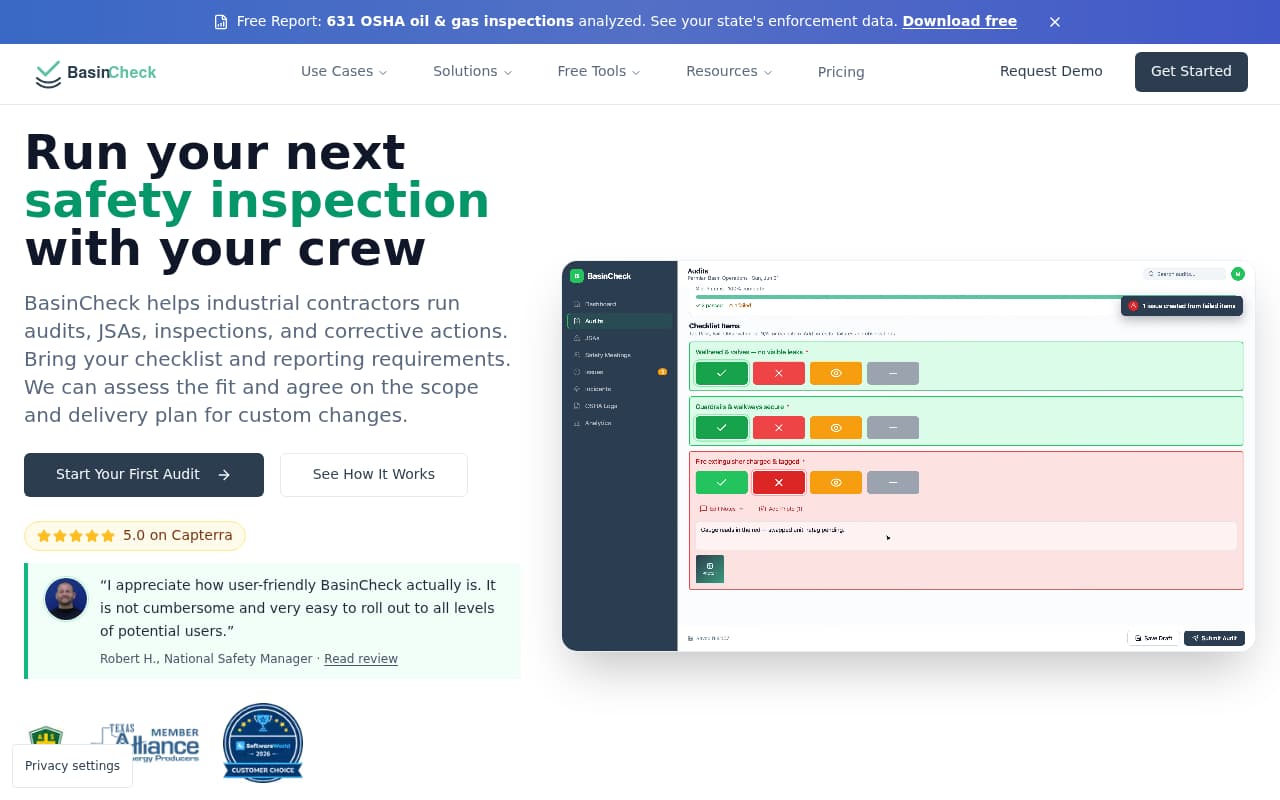
Where a complex system like KPA EHS can overwhelm field personnel, BasinCheck delivers focused efficiency. The entire platform is designed for rapid adoption and consistent use by crews in the truck and on the rig, not just by safety managers behind a desk. This difference is clear in practice:
- Intuitive Mobile App: We prioritize speed and simplicity. Completing a JSA or inspection takes minutes, encouraging 100% participation from your team.
- Industry-Standard Checklists: BasinCheck comes pre-loaded with the forms you actually use, helping you stay audit-ready for major operators from day one.
- Streamlined Corrective Actions: Identify a hazard, snap a photo, assign a fix, and track it to completion in seconds. No more issues falling through the cracks.
A Clear Choice for Oil & Gas Contractors
The decision is straightforward. If your organization requires a single EHS system to manage safety across vastly different industries, a generalist platform may be a fit. But for oil and gas contractors, that approach means compromising on the features and usability that matter most.
BasinCheck is faster to implement, offers transparent pricing, is easier for crews to adopt, and more effective at creating the defensible audit trail you need to protect your business and win more work. It is the purpose-built tool for the job.
“We spent $200k/year on consultants just to keep our old system running. We couldn't even add a new location without a support ticket.”
The Right EHS Software for Oil & Gas Contractors
Choosing the right EHS software is a critical decision. While a generalist platform like KPA EHS offers a wide range of features, it may lack the specific focus required for the demanding oilfield environment. Your operation needs a tool that isn't just comprehensive, but is built from the ground up to handle the realities of remote work, stringent OSHA compliance, and fast-paced field operations.
This is where a purpose-built solution makes a difference. BasinCheck was designed exclusively for oil and gas contractors. It delivers field-ready offline functionality that works every time, a simple interface your crews will actually use, and powerful reporting that keeps managers in control and audit-ready. Don't settle for a one-size-fits-all solution when your business demands a specialist tool.
Take the next step to protect your crew, your compliance, and your company.
Frequently Asked Questions
Ready to See What Field-Ready Actually Looks Like?
Stop building forms from scratch. See how BasinCheck gets your crews audit-ready in days, not months.