
Manufacturing EHS software has a credibility problem. Enterprise platforms promise everything — incident management, ergonomics, chemical tracking, environmental compliance, ISO certification support — but the implementations take 6–12 months, the mobile apps disappoint plant floor workers, and the per-user pricing quietly inflates as you add shift workers, contractors, and temporary staff. Meanwhile, the lightweight inspection apps are fast to deploy but lack the compliance depth that keeps your plant out of OSHA's crosshairs.
The right EHS platform for your manufacturing operation depends on what you're actually trying to solve. A food manufacturer needing FDA and GMP compliance has different requirements than a metal fabrication shop tracking machine guarding and LOTO procedures. A single-plant operation with 80 employees needs different tooling than a multi-site manufacturer running 15 facilities across three states. And critically, the people using the software — plant floor supervisors, maintenance technicians, line workers — need something that works on a phone or tablet in a noisy, dirty environment where they have 90 seconds of patience for data entry.
We evaluated each platform below from the perspective of a manufacturing EHS manager who needs OSHA compliance, incident reduction, and plant floor adoption — not a consultant who needs impressive dashboards for quarterly presentations. Here's what we found.
| # | Product | Best for | Pricing |
|---|---|---|---|
| 1 | VelocityEHS | Manufacturing plants where ergonomic injuries (MSDs) are a top concern and chemical/SDS management needs to be accessible plant-wide | Subscription-based, no separate per-user fees; estimated $10–$30/user/mo depending on modules; custom quotes required |
| 2 | Intelex | Large, multi-site manufacturers that need unified environmental reporting, safety management, and quality systems across 10+ facilities | Starting ~$13/user/mo for entry modules; enterprise deployments $10,000+/month; implementation $10,000–$100,000+; custom quotes required |
| 3 | EHS Insight | Mid-size manufacturers (100–1,000 employees) who need full EHS functionality without enterprise pricing or multi-month implementations | Subscription-based, module-driven; custom quotes based on employee count, modules, and support level; claims 267% ROI within first year |
| 4 | BasinCheck | Small-to-mid manufacturers (20–300 employees) who need OSHA compliance, offline inspections, and predictable monthly costs — especially those with field service or remote operations alongside plant work | From $149/mo (flat team pricing — Starter: $149, Standard: $299, Pro: $599, Enterprise: $1,200+; no per-user fees) |
| 5 | SafetyCulture (iAuditor) | Manufacturing plants that need a fast-deploy inspection and audit layer on the plant floor — especially as a complement to an existing EHS system | Free plan (up to 10 users); Premium from ~$24/user/mo billed annually; Enterprise custom pricing |
| 6 | Benchmark Gensuite (Benchmark ESG) | Large, multi-site manufacturers (1,000+ employees) that need global EHS management with multi-language support and no per-user cost scaling | Subscription-based with no per-user or up-front license costs; custom quotes required; positioned as cost-effective relative to enterprise competitors |
| 7 | MasterControl | Pharmaceutical, medical device, biotech, and food manufacturers where FDA compliance and GMP documentation are the primary regulatory drivers — not general manufacturing EHS | Manufacturing Excellence from ~$1,000/mo per user; Quality Excellence from ~$25,000/year; significant implementation investment; custom quotes only |
VelocityEHS
Mid-market EHS platform with industry-leading industrial ergonomics and chemical management
Best For
Manufacturing plants where ergonomic injuries (MSDs) are a top concern and chemical/SDS management needs to be accessible plant-wide
Pricing
Subscription-based, no separate per-user fees; estimated $10–$30/user/mo depending on modules; custom quotes required
VelocityEHS is a mid-market to enterprise EHS platform that stands out in manufacturing for two specific capabilities: industrial ergonomics and chemical management. The ergonomics module uses AI-powered 3D motion capture to analyze worker movements and score musculoskeletal disorder (MSD) risk at the task level. For manufacturing plants where repetitive motion injuries are a top OSHA recordable category, this isn't a nice-to-have feature — it's a direct path to reducing your incident rate. Carhartt publicly reported a 50% reduction in OSHA recordables after deploying VelocityEHS for ergonomic assessments.
Chemical management is the other area where VelocityEHS leads. The SDS (Safety Data Sheet) management system provides Right-to-Know compliance with plant-wide access from any device. Line workers can pull up chemical hazard information from a tablet on the plant floor, which is an OSHA requirement that many manufacturers still handle with paper binders at fixed stations. For facilities managing hundreds of chemical products, this digital access eliminates the administrative burden of maintaining physical SDS libraries.
The trade-off is implementation complexity and mobile parity. VelocityEHS is a broad platform with modules for incidents, inspections, environmental compliance, ESG reporting, and more. Getting full value requires meaningful configuration and onboarding time — EHS managers at single-plant operations may find that the platform's breadth exceeds what they need. The mobile app, while functional, doesn't match the desktop experience, which can frustrate plant floor supervisors who do most of their safety work away from a desk.
Key Features
Pros
- Industrial ergonomics module is genuinely differentiated — AI-powered 3D motion capture scores MSD risk on specific tasks; Carhartt reported a 50% reduction in OSHA recordables using this feature
- Chemical management and SDS access from any device is the best in the space — critical for manufacturing plants where workers need instant access to hazard information at every workstation
- No separate per-user fees means you can roll out access to every shift worker without cost anxiety from headcount changes
Cons
- Mobile app has fewer functions than the desktop version — plant floor workers may find some workflows require going back to a computer to complete
- Steep learning curve across the module library — new EHS managers report needing significant onboarding time before they can configure the platform for their specific plant operations
- Pricing is not transparent — you must engage with sales to get a quote, which makes budgeting difficult during the evaluation phase
Verdict: The strongest choice for manufacturing plants where ergonomic injuries and chemical management are primary EHS concerns. The AI-powered ergonomics module is genuinely differentiated. Best suited for mid-size to enterprise manufacturers who can invest in proper implementation.
Intelex
Enterprise EHSQ platform for multi-site manufacturers needing environmental and safety compliance at scale
Best For
Large, multi-site manufacturers that need unified environmental reporting, safety management, and quality systems across 10+ facilities
Pricing
Starting ~$13/user/mo for entry modules; enterprise deployments $10,000+/month; implementation $10,000–$100,000+; custom quotes required
Intelex is owned by Fortive Corporation and serves 1,400+ clients with 3.5 million users globally. It's an enterprise EHSQ platform — the "Q" is important, because Intelex integrates quality management with environmental and safety in a way that most EHS-only platforms don't. For large manufacturers operating under ISO 9001, ISO 14001, and ISO 45001 simultaneously, this integration eliminates the data silos that come from running separate quality and EHS systems.
The environmental compliance capabilities are where Intelex separates from the field. Multi-site manufacturers tracking air emissions, wastewater discharge, and hazardous waste across dozens of facilities need consolidated EPA reporting that aggregates facility-level data into corporate-level compliance documentation. Intelex handles this at a scale that most competitors don't attempt — it's purpose-built for the environmental reporting requirements that keep corporate EHS directors up at night.
For single-plant or mid-size manufacturers, Intelex is likely overkill. The implementation investment (both cost and time) assumes a dedicated project team, and the platform's depth creates a learning curve that a lean EHS team at a 200-person plant will struggle to absorb. The mobile experience, despite Verdantix recognition, is a documented gap in user reviews — plant floor workers consistently prefer the desktop interface, which undermines adoption for the people who generate the most safety data.
Key Features
Pros
- Unmatched depth for multi-site environmental reporting — manufacturers running 50+ facilities get consolidated EPA compliance, emissions tracking, and waste management in one platform
- The drag-and-drop module builder lets you configure custom EHS workflows without vendor consulting or custom development — powerful for manufacturers with unique processes
- Verdantix-rated #1 in Safety & Mobile for enterprise EHS; G2 Enterprise EHS Leader — validated by third-party analysts, not just marketing claims
Cons
- Mobile app lacks feature parity with desktop — several core functions behave differently or are unavailable on mobile, which limits plant floor adoption
- Implementation costs ($10K–$100K+) and timeline (months) make it impractical for manufacturers under 500 employees or single-plant operations
- Feature density creates a steep learning curve — report building and dashboard creation are frequently cited as pain points in user reviews
Verdict: The enterprise choice for multi-site manufacturers that need unified EHSQ management and deep environmental compliance reporting. Not practical for single-plant operations or manufacturers under 500 employees — the implementation investment and feature complexity exceed what lean EHS teams can absorb.
EHS Insight
Affordable, configurable EHS platform with strong offline mobile capability
Best For
Mid-size manufacturers (100–1,000 employees) who need full EHS functionality without enterprise pricing or multi-month implementations
Pricing
Subscription-based, module-driven; custom quotes based on employee count, modules, and support level; claims 267% ROI within first year
EHS Insight positions itself in the gap between lightweight inspection apps and enterprise EHS platforms. For mid-size manufacturers — companies with 100–1,000 employees running one to five plants — the platform offers full EHS functionality (incidents, audits, inspections, compliance tracking, BBS observations) without the six-figure implementation costs and year-long deployments that enterprise platforms require.
The offline mobile capability is a genuine differentiator for manufacturing environments. Plant floor areas often have dead zones — inside metal buildings, near heavy equipment, in basement levels — where wireless coverage is unreliable. EHS Insight's mobile app claims to be the industry's first fully offline EHS platform, allowing workers to complete inspections, log incidents, and update compliance records without connectivity. Data syncs automatically when the device reconnects. For manufacturers whose plant floor adoption of EHS software depends on reliability in spotty-signal environments, this matters more than any dashboard feature.
The AI Copilot feature is the platform's most forward-looking capability. It analyzes incident and observation data to identify SIF (Serious Injury & Fatality) precursors — the near misses and unsafe conditions that statistically precede severe injuries. For EHS managers at manufacturing plants generating hundreds of observations per month, this automated pattern recognition surfaces the signals that manual review misses. ISO 45001, 14001, and 9001 support is built in for manufacturers maintaining multiple certifications.
Key Features
Pros
- One of the few EHS platforms with a genuinely functional offline mobile app — plant floor workers can complete audits, log incidents, and update records without signal, with automatic sync when connectivity returns
- AI Copilot identifies SIF precursors from your incident and observation data — surfaces the near misses that could become serious injuries before they escalate
- Consistently praised by reviewers for customer support responsiveness and willingness to listen to feature requests — important for mid-size manufacturers without dedicated IT teams
Cons
- Initial setup and configuration can be time-consuming — not a same-day deployment; expect weeks of configuration to match your plant's specific workflows
- Incident reporting workflow is described as confusing by some users — the event reporting process requires training to navigate effectively
- Training catalog does not include OSHA-approved courses (OSHA-10, OSHA-30, HAZWOPER) — you will need a separate training provider for regulatory certifications
Verdict: The best mid-market EHS platform for manufacturers who need strong offline capability, AI-powered insights, and ISO certification support without enterprise pricing. Setup requires patience, but the ongoing value for mid-size plant operations is strong.
Try BasinCheck Free for 7 Days
Check BasinCheck plan limits and pricing against your requirements.
Start Free TrialBasinCheck
Flat-priced safety software with full offline capability — built for field-heavy industrial operations

Best For
Small-to-mid manufacturers (20–300 employees) who need OSHA compliance, offline inspections, and predictable monthly costs — especially those with field service or remote operations alongside plant work
Pricing
From $149/mo (flat team pricing — Starter: $149, Standard: $299, Pro: $599, Enterprise: $1,200+; no per-user fees)
BasinCheck was built for oilfield contractors managing safety across remote locations with unreliable connectivity and fluctuating crew sizes. That operational reality — remote sites, rotating workers, OSHA compliance pressure, thin margins — maps directly to small and mid-size manufacturers with similar challenges. A fabrication shop with 80 employees across two shifts, a food processing plant with seasonal workers, or a manufacturer with both plant operations and field service teams will find BasinCheck's flat pricing and offline capability compelling.
The offline-first architecture is BasinCheck's strongest differentiator for plant environments. This isn't a mode where you can view previously loaded data — supervisors can create complete safety inspections, log incidents with photos and GPS, and build JSAs from scratch with zero connectivity. Everything syncs with ECDSA cryptographic signatures when the device reconnects, providing tamper-proof verification that the data was captured at the stated time and location. For manufacturers with plant floor dead zones or remote satellite facilities, this is the difference between safety data being captured in real time versus being reconstructed from memory at a desk hours later.
The honest trade-off is manufacturing-specific depth. BasinCheck doesn't have built-in LOTO procedure management, machine guarding inspection workflows, ergonomic assessment tools, or chemical/SDS management. You can create custom audit templates for these processes, but dedicated manufacturing EHS platforms like VelocityEHS and EHS Insight have deeper, purpose-built support for these workflows. For manufacturers whose primary need is OSHA compliance, incident management, and inspections at a predictable cost — and especially those with field operations alongside plant work — BasinCheck delivers strong value without per-user pricing complexity.
Key Features
Pros
- Flat pricing ($149–$599/mo) is the most predictable cost model on this list — your bill stays the same whether you run two shifts or three, and adding temporary workers or contractors doesn't change what you pay
- True offline-first architecture — not cache-based viewing, but full creation of audits, incidents, and JSAs offline with cryptographic verification; this works in metal buildings, basements, and areas where enterprise platforms lose connectivity
- OSHA compliance automation reduces manual recordkeeping — incidents auto-classify by OSHA category, 300/300A/301 forms auto-generate, and corrective actions create themselves from failed inspection items
Cons
- Built for oil and gas field operations — manufacturing-specific workflows like LOTO procedure tracking, machine guarding checklists, and ergonomics assessment are not native features (you can create custom templates, but dedicated manufacturing platforms have deeper built-in support)
- No environmental compliance modules (emissions, waste tracking, wastewater reporting) — manufacturers with EPA reporting requirements need a separate solution for environmental management
- No chemical management or SDS library — plants managing hundreds of chemical products will need a dedicated SDS management tool alongside BasinCheck
Verdict: The best value for small-to-mid manufacturers who need OSHA compliance, offline-first inspections, and flat pricing. Ideal for operations that span plant floor and field work. Manufacturers needing ergonomics, chemical management, or environmental compliance should pair BasinCheck with specialized tools or choose a manufacturing-native platform.
SafetyCulture (iAuditor)
The most widely adopted inspection platform with 100,000+ templates and best-in-class mobile experience

Best For
Manufacturing plants that need a fast-deploy inspection and audit layer on the plant floor — especially as a complement to an existing EHS system
Pricing
Free plan (up to 10 users); Premium from ~$24/user/mo billed annually; Enterprise custom pricing
SafetyCulture is the most widely adopted inspection platform globally, used by over 75,000 organizations. For manufacturing plants, it excels as an inspection and audit layer — the tool your line supervisors and maintenance technicians use to complete daily checklists, report hazards, and document conditions on the plant floor. The mobile app is the best in the space for speed and usability, and the template library includes ready-to-use manufacturing checklists for LOTO procedures, machine guarding inspections, forklift safety checks, and PPE compliance.
The free plan (up to 10 users) provides a practical way to pilot digital inspections without budget approval. A quality manager can deploy SafetyCulture on a single production line, prove the value of digital checklists, and build a business case for plant-wide rollout. The QR code hazard reporting feature is particularly useful for manufacturing — placing QR codes at workstations, equipment, and hazard points lets any worker report an unsafe condition in 30 seconds from their phone.
The limitation is scope. SafetyCulture is an inspection tool, not an EHS management system. It doesn't generate OSHA 300 logs, doesn't manage incident investigations with root cause analysis, doesn't track corrective actions through resolution, and doesn't handle environmental compliance. Manufacturing plants that need a complete EHS platform will use SafetyCulture as one layer in a broader stack — not as a standalone solution. The per-user pricing also becomes expensive at manufacturing scale: an 80-person plant across three shifts pays nearly $2,000/month for an inspection tool that larger EHS platforms include as one module among many.
Key Features
Pros
- Best-in-class mobile experience for plant floor use — the app is fast, intuitive, and designed for workers who have 60 seconds to complete a checklist between tasks
- Free plan for up to 10 users provides a zero-risk way to pilot digital inspections on a single production line before committing budget
- Massive template library includes manufacturing-specific checklists (LOTO, machine guarding, forklift inspections, PPE compliance) that you can deploy on day one
Cons
- Per-user pricing scales poorly for manufacturing — a plant with 80 workers across three shifts at $24/user/month costs $1,920/month, which exceeds what several full EHS platforms charge
- Not an EHS management system — no OSHA 300 log generation, no incident investigation workflows, no corrective action management, no environmental compliance; it is an inspection layer only
- Report customization is limited — EHS managers who need specific analytics formats often export to Excel for additional processing
Verdict: The best mobile inspection app for manufacturing plant floors. Unmatched for speed of deployment, template library, and worker adoption. But it is an inspection layer — not a complete EHS system — and per-user pricing gets expensive at manufacturing headcounts.
Benchmark Gensuite (Benchmark ESG)
Enterprise EHS platform with AI agents and no per-user licensing — built from GE's internal EHS system
Best For
Large, multi-site manufacturers (1,000+ employees) that need global EHS management with multi-language support and no per-user cost scaling
Pricing
Subscription-based with no per-user or up-front license costs; custom quotes required; positioned as cost-effective relative to enterprise competitors
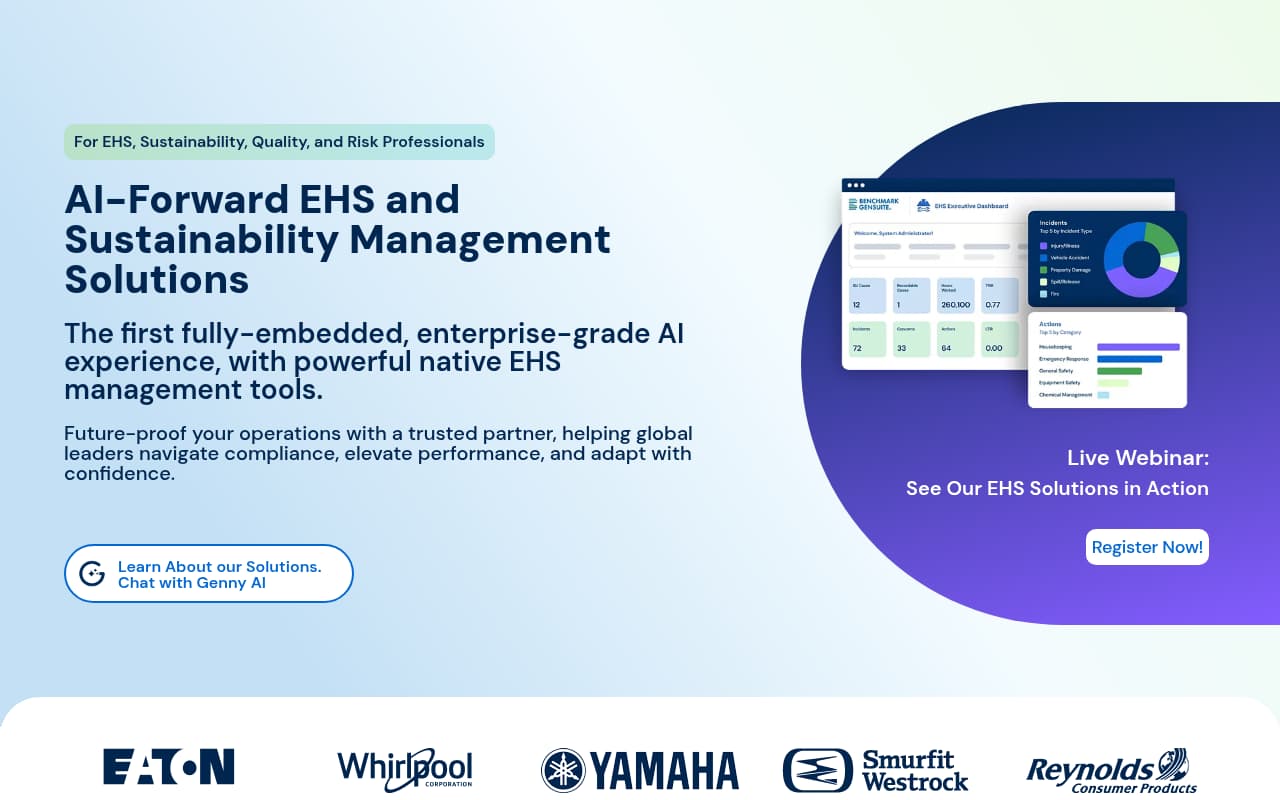
Benchmark Gensuite (recently rebranded as Benchmark ESG) traces its origins to GE's internal EHS management system, which gives it a depth of practitioner-built workflow knowledge that newer competitors lack. The platform serves approximately 400 enterprise customers across 25,000+ sites with 4 million registered users. For large manufacturers running global operations across multiple countries, the multi-language support and no-per-user licensing model are the primary draws.
The AI agents, launched in 2025, are the platform's most significant recent innovation. These autonomous agents handle permit management (reviewing, approving, and tracking permits to work) and chemical management (extracting SDS data, classifying hazards, populating compliance records) — tasks that traditionally consume hours of an EHS coordinator's time. For manufacturers managing hundreds of active permits and thousands of chemical products across multiple facilities, the automation is a measurable time savings.
The persistent concern is usability. Benchmark Gensuite's interface reflects its enterprise heritage — it's powerful but not intuitive, and plant floor adoption is a documented challenge. User reviews consistently flag navigation difficulties, and the mobile experience doesn't meet the expectations set by consumer-grade apps that factory workers use in their personal lives. For manufacturers where plant floor data capture is the primary goal, the adoption gap between what the platform can do and what workers will actually use is the critical risk.
Key Features
Pros
- No per-user fees means unrestricted access for every plant worker, shift supervisor, and contractor — critical for large manufacturers where per-seat licensing across thousands of employees would be prohibitively expensive
- AI agents (launched 2025) automate permit management and chemical management reviews, reducing administrative hours from hours to minutes — a genuine productivity improvement for EHS teams managing hundreds of permits
- Born from GE's internal EHS system — 25+ years of practitioner-built workflows means the platform reflects how large manufacturers actually manage EHS, not how software vendors think they should
Cons
- User interface is not intuitive — plant floor workers frequently struggle with the navigation, and one major customer reportedly spent $100K+ on mobile tools that field personnel refused to use due to usability issues
- Customer support response times can reach a week — workable for non-urgent issues but problematic when you need help resolving a compliance deadline or incident investigation
- Mobile app reliability is inconsistent — field workers report preferring desktop, which defeats the purpose for plant floor safety data capture
Verdict: A strong enterprise EHS platform for large, multi-site manufacturers who need global compliance management without per-user fees. The AI agents are genuinely innovative. But usability challenges mean plant floor adoption requires significant change management — budget for training and expect resistance.
MasterControl
Quality management system with EHS overlap for FDA-regulated and GMP-compliant manufacturers
Best For
Pharmaceutical, medical device, biotech, and food manufacturers where FDA compliance and GMP documentation are the primary regulatory drivers — not general manufacturing EHS
Pricing
Manufacturing Excellence from ~$1,000/mo per user; Quality Excellence from ~$25,000/year; significant implementation investment; custom quotes only
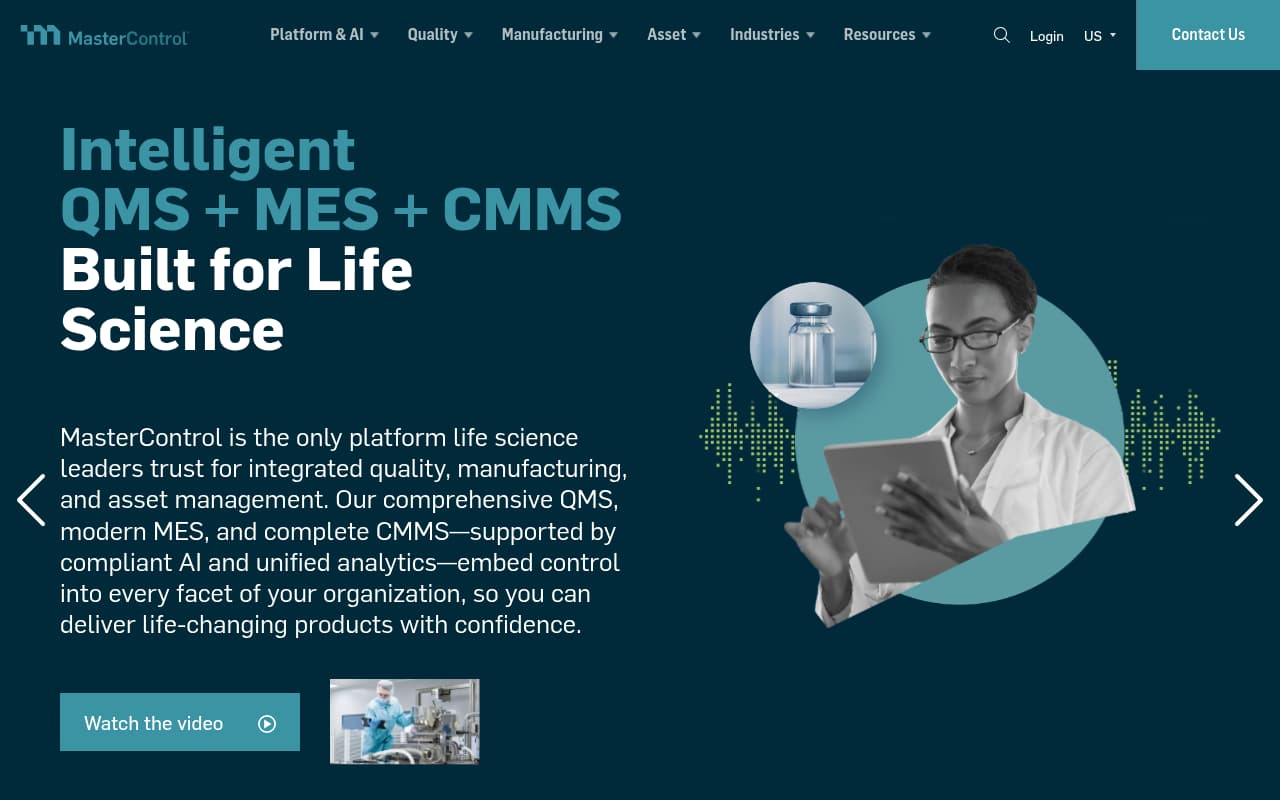
MasterControl is not an EHS platform — it's a quality management system (QMS) and manufacturing execution system (MES) for regulated industries. It appears on this list because manufacturers in pharmaceutical, medical device, biotech, and food processing industries often conflate quality compliance with EHS, and MasterControl handles the quality side with a depth that no EHS platform matches. If your primary regulatory driver is FDA, GMP, or ISO 13485 rather than OSHA, MasterControl is what your compliance team is actually looking for.
The platform's strength is regulatory documentation. Electronic batch records replace paper-based manufacturing documentation with full 21 CFR Part 11 compliance — every action is logged, every approval is tracked, and every deviation triggers a documented investigation. For manufacturers where a single documentation failure can result in FDA warning letters or product recalls, this level of traceability is non-negotiable. Users report zero regulatory observations post-implementation, which is the ultimate validation.
For general manufacturers — metal fabrication, plastics, assembly, or any operation where OSHA compliance and workplace safety are the primary concerns rather than FDA — MasterControl is the wrong tool. It's expensive (~$1,000/month per user), complex to implement, and doesn't include the incident management, safety inspections, or OSHA recordkeeping features that manufacturing EHS managers need. It belongs on this list as a category clarification: if you're a regulated manufacturer searching for "manufacturing EHS software" but your real need is quality compliance, MasterControl is the answer. Everyone else should look at the other six options.
Key Features
Pros
- The gold standard for FDA 21 CFR Part 11 compliance and ISO 13485 (medical devices) — manufacturers in regulated industries report zero regulatory observations after implementation
- End-to-end traceability from document control through production means every quality and safety event has a complete audit trail that satisfies the most stringent regulators
- Seamless integration between quality management and manufacturing execution (QMS + MES) eliminates the gap between quality documentation and actual production processes
Cons
- Not an EHS platform — no OSHA recordkeeping, no incident management, no safety inspections, no environmental compliance; it is a quality management system that overlaps with safety at the CAPA and training layers
- The most expensive option on this list per user (~$1,000/mo per user for Manufacturing Excellence) with significant implementation investment — only justified for manufacturers with heavy regulatory requirements
- Steep learning curve and dated UI — any workflow change requires documentation, testing, and approval; not designed for the rapid iteration that general manufacturers need
Verdict: The right choice for FDA-regulated, GMP-compliant manufacturers where quality documentation is the primary compliance need. Not a general manufacturing EHS platform — if OSHA compliance and workplace safety are your priority, MasterControl is not what you need.
Side-by-side feature comparison
| Software | Best For | Starting Price | Pricing Model | OSHA 300 Logs | Offline Mode | Ergonomics | Chemical/SDS Mgmt |
|---|---|---|---|---|---|---|---|
| VelocityEHS | Ergonomics + chemicals | ~$10/user/mo | Module-based | Yes | Limited | Best-in-class (AI) | Best-in-class |
| Intelex | Multi-site enterprise | ~$13/user/mo | Module-based | Yes | Weak | Basic | Yes |
| EHS Insight | Mid-size plants | Custom quote | Module-based | Partial | ✓ (full offline) | No | Limited |
| BasinCheck | Flat pricing + offline | $149/mo flat | Flat monthly | ✓ (300/300A/301) | ✓ (full offline-first) | No | No |
| SafetyCulture (iAuditor) | Plant floor inspections | Free / $24/user/mo | Per-user | No | Yes | No | No |
| Benchmark Gensuite (Benchmark ESG) | — | — | — | — | — | — | — |
| MasterControl | FDA/GMP regulated | ~$1,000/user/mo | Per-user | No | No | No | No |
How we evaluated these tools
We evaluated 20+ EHS platforms and selected these 7 based on criteria that matter most to manufacturing plant operations teams:
- OSHA compliance depth — Does the platform auto-generate OSHA 300/300A/301 forms, classify incidents by OSHA category, and maintain audit-ready records? Or does compliance require manual exports and spreadsheet assembly?
- Plant floor adoption — Can a line supervisor or maintenance tech complete an inspection on a phone or tablet in under two minutes? Is the mobile experience designed for gloved hands in a noisy, dirty environment, or does it feel like a desktop app shrunk to a phone screen?
- Offline reliability — Does the platform function in plant floor dead zones (metal buildings, basements, areas near heavy equipment) where wireless coverage drops? Can workers capture data offline and sync later, or does lost connectivity mean lost data?
- Manufacturing-specific workflows — Does the platform include LOTO procedures, machine guarding checklists, ergonomic assessments, chemical management, and process safety features, or is it a general safety tool with manufacturing templates bolted on?
- Cost predictability — Does pricing scale linearly with headcount (per-user), creating unpredictable costs when you add shifts or contractors? Or does the model provide budget stability for EHS managers who need to forecast annual software spend?
- ISO certification support — Does the platform support ISO 45001, ISO 14001, and ISO 9001 audit workflows and documentation requirements for manufacturers maintaining multiple certifications?
Product information was gathered from official vendor websites, verified user reviews on G2, Capterra, and GetApp, and third-party analyst reports (Verdantix). Pricing was confirmed through published pricing pages or recent (2025–2026) review sources where available.
Frequently Asked Questions
What is the best EHS software for manufacturing plants?
It depends on your size and primary compliance needs. VelocityEHS is the strongest choice for plants focused on ergonomic injury reduction and chemical management. BasinCheck offers the best value for small-to-mid manufacturers who need OSHA compliance, offline capability, and predictable flat pricing. EHS Insight is the best mid-market option with strong offline mobile capability. SafetyCulture is the fastest to deploy as a plant floor inspection layer. Intelex and Benchmark Gensuite serve large, multi-site enterprise operations.
How much does manufacturing EHS software cost?
Costs range from free (SafetyCulture free tier for up to 10 users) to $10,000+/month for enterprise deployments. Per-user platforms typically cost $10–$50/user/month — an 80-person plant across three shifts pays $800–$4,000/month. Flat-priced alternatives like BasinCheck ($149–$599/month) provide cost predictability. Enterprise platforms (Intelex, Benchmark Gensuite) use custom quotes based on modules and sites. Budget for implementation costs separately — enterprise platforms typically require $10,000–$100,000+ in setup.
Do manufacturing plants need different EHS software than construction or oil & gas?
Manufacturing plants have unique EHS requirements that general safety platforms may not cover: LOTO (Lockout/Tagout) procedure management, machine guarding compliance, ergonomic assessment for repetitive tasks, chemical/SDS management for hundreds of products, process safety management (PSM), and environmental compliance (emissions, waste, wastewater). Platforms like VelocityEHS, Intelex, and EHS Insight have dedicated manufacturing modules. General safety tools like BasinCheck and SafetyCulture can handle inspections and OSHA recordkeeping but may need supplementary tools for manufacturing-specific workflows.
Can EHS software help with ISO 45001 certification for manufacturing?
Yes. VelocityEHS, Intelex, and EHS Insight explicitly support ISO 45001 audit workflows and documentation requirements. The platforms help you maintain the management system documentation, conduct internal audits, track corrective actions, and generate the evidence that ISO auditors require. BasinCheck supports the inspection and incident management aspects of ISO 45001. SafetyCulture provides inspection-level templates. For manufacturers pursuing ISO 45001, 14001, and 9001 simultaneously, Intelex offers the deepest integrated support.
Why does offline capability matter for manufacturing EHS software?
Manufacturing plants often have wireless dead zones — inside metal buildings, near heavy electrical equipment, in basement or sub-grade levels, and in areas where signal is blocked by concrete and machinery. If your EHS software requires constant connectivity, plant floor workers lose data when signal drops, skip inspections they can't complete, and reconstruct observations from memory hours later. Platforms with true offline capability (BasinCheck, EHS Insight, SafetyCulture) let workers capture data in real time regardless of connectivity, which produces more accurate safety records and higher completion rates.
Final verdict
Manufacturing EHS software isn't one-size-fits-all. A pharmaceutical plant subject to FDA scrutiny has fundamentally different needs than a metal fabrication shop focused on machine guarding and LOTO compliance. The seven platforms on this list cover the full spectrum — from enterprise EHSQ suites managing global operations to affordable inspection tools that get your plant floor off paper by the end of the week.
VelocityEHS leads for manufacturers where ergonomic injuries and chemical management are the top EHS priorities. Intelex and Benchmark Gensuite serve large, multi-site enterprises needing global compliance. EHS Insight is the strongest mid-market option with genuine offline capability. BasinCheck offers the most predictable pricing for small-to-mid manufacturers who need OSHA compliance and offline inspections without per-user cost anxiety. SafetyCulture is the fastest path to plant floor inspection digitization. And MasterControl is the right answer for regulated manufacturers whose real need is quality compliance, not general EHS.
The most expensive EHS failure in manufacturing isn't software cost — it's the recordable injury that your current system failed to predict, document, or prevent. OSHA's average serious violation penalty exceeds $16,000, and a single lost-time incident costs manufacturers $42,000+ in direct and indirect costs. Pick the platform that matches your plant's specific needs, deploy it to your floor-level supervisors (not just the EHS office), and make sure it works when the WiFi doesn't.