EHS software evaluation guide
SafetyCulture vs VelocityEHS: an evidence-led guide for EHS buyers
This is not a winner-picks-all feature grid. It maps what each vendor currently documents, the operational difference that may matter, and the proof to request before you put either system in front of field teams.
SafetyCulture
Frontline operations platform
Start here if the near-term job is consistent mobile inspections, evidence capture, action ownership, and adjacent frontline workflows.
VelocityEHS
Unified enterprise EHS suite
Start here if a broader program across safety, chemical management, ergonomics, operational risk, contractor oversight, and centralized reporting is already in scope.

How to read this guide
Documented capability is a starting point, not a score.
We reviewed public product pages from SafetyCulture and VelocityEHS on July 20, 2026. We did not run a vendor trial, inspect a customer tenant, or assign either vendor a numerical score. Claims in the evidence matrix are limited to those sources. The practical guidance is our editorial interpretation for a buyer who needs to evaluate field safety work.
1
Read the vendor claim
Use the linked first-party source.
2
Run the live workflow
Use one form your crew already knows.
3
Get terms in writing
Compare scope, services, support, and export.
Evidence matrix
The decision areas that should shape the shortlist
The difference is more useful when you follow the work from a field check to a closed record, then test the platform scope and commercial model behind it.
SafetyCulture documents
Its inspection documentation describes mobile and offline access, auto-save and sync, photo and video capture, signatures, and approvals.
VelocityEHS documents
Its Inspections material describes custom digital checklists, photo and document attachments, offline mobile completion via the VelocityEHS mobile app, and centralized scheduling and reporting.
Prove this in the demo
Run one actual field form with no signal. Add a photo, a signature, and a failed item. Ask what appears after synchronization and what can be edited later.
SafetyCulture documents
SafetyCulture documents tasks and corrective actions that can be assigned and tracked, including actions linked to inspections.
VelocityEHS documents
VelocityEHS documents integrated corrective actions for inspection findings, plus broader action management and incident-linked corrective actions across the Safety Solution.
Prove this in the demo
Fail an inspection item, assign an owner and deadline, attach closeout evidence, reject a weak closeout, then export the full activity history.
SafetyCulture documents
The vendor positions the product as a frontline operations platform that extends from inspections into actions, training, assets, and connected workflows.
VelocityEHS documents
VelocityEHS positions the Accelerate Platform as a unified EHS suite with 24+ products spanning safety, chemical management, ergonomics, operational risk, contractor safety, environmental compliance, and ESG.
Prove this in the demo
List the programs you need in the next 24 months. Have each vendor mark which are included now, which need configuration or another module, and which need an integration.
SafetyCulture documents
The public materials emphasize a frontline platform and configurable operational workflows. The depth of governance needed for your organization should be tested in a live build.
VelocityEHS documents
The public materials emphasize configurable checklists, centralized administration across products, dashboards, reporting, and implementation and onboarding support for enterprise deployments.
Prove this in the demo
Ask an administrator, not a salesperson, to change a field, approval step, role permission, report, and record-retention rule. Document who can make each change.
SafetyCulture documents
SafetyCulture publishes a Premium Full annual-billing price of $24 per user per month. Plan, volume, and service details still need confirmation.
VelocityEHS documents
VelocityEHS directs buyers to schedule a demo for product and platform pricing. Scope, selected modules, services, and commercial terms should therefore be documented in the proposal.
Prove this in the demo
Price the same user population, locations, implementation work, storage, integrations, support level, renewal terms, and exit/export obligations in writing.
Buyer context
Choose a first demo based on the job your system must do.
A smaller team should not buy an enterprise suite because it has more modules. A multi-program organization should not buy a light operational tool if it cannot govern the work it must consolidate. Start with the operating reality below.
Frontline operations team
Start with SafetyCulture
It deserves the first demo when the urgent job is consistent field inspections, evidence capture, action ownership, and a platform that can extend into related frontline workflows.
Do not skip this
Do not infer fit from the checklist alone. Test offline behavior, action closeout, role permissions, reporting, and the programs you expect to add next.
Enterprise EHS organization
Start with VelocityEHS
It deserves the first demo when you need a broader EHS suite across safety, chemical management, ergonomics, operational risk, contractor oversight, and centralized reporting on one platform.
Do not skip this
Ask for a realistic implementation plan with named modules, configuration responsibilities, data migration, and a working field-user journey.
Oilfield contractor safety team
Add BasinCheck to the evaluation
A contractor may prefer a focused product when the recurring work is field records, corrective actions, safety meetings, JSAs, permits, incidents, and OSHA recordkeeping rather than a full enterprise suite.
Do not skip this
Evaluate BasinCheck on the same proof standard. Bring one active customer requirement or operator audit request and trace it from field entry to closeout.

The BasinCheck counterpoint
A narrower operating system can be the more useful one.
BasinCheck is designed for oilfield contractors rather than every enterprise EHS use case. If your recurring work is field safety records, corrective actions, safety meetings, JSAs, permits, incidents, and OSHA recordkeeping, evaluate whether a focused workflow gives supervisors a more direct route from field entry to a usable record.
This is not a claim that a focused product is better for every buyer. It is a reason to include it when operator requirements, crew adoption, and proof of completed safety work are the actual buying criteria.
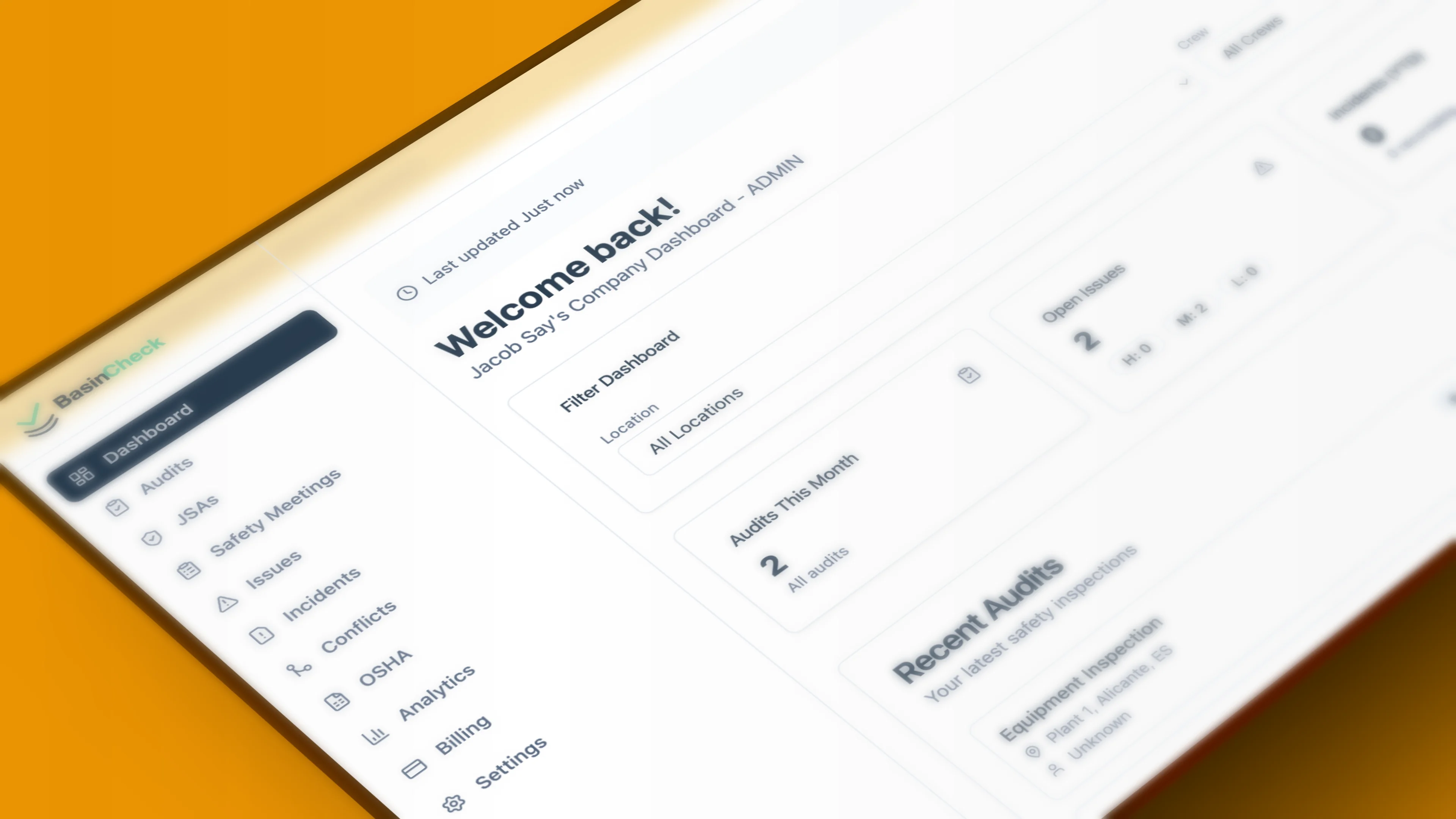
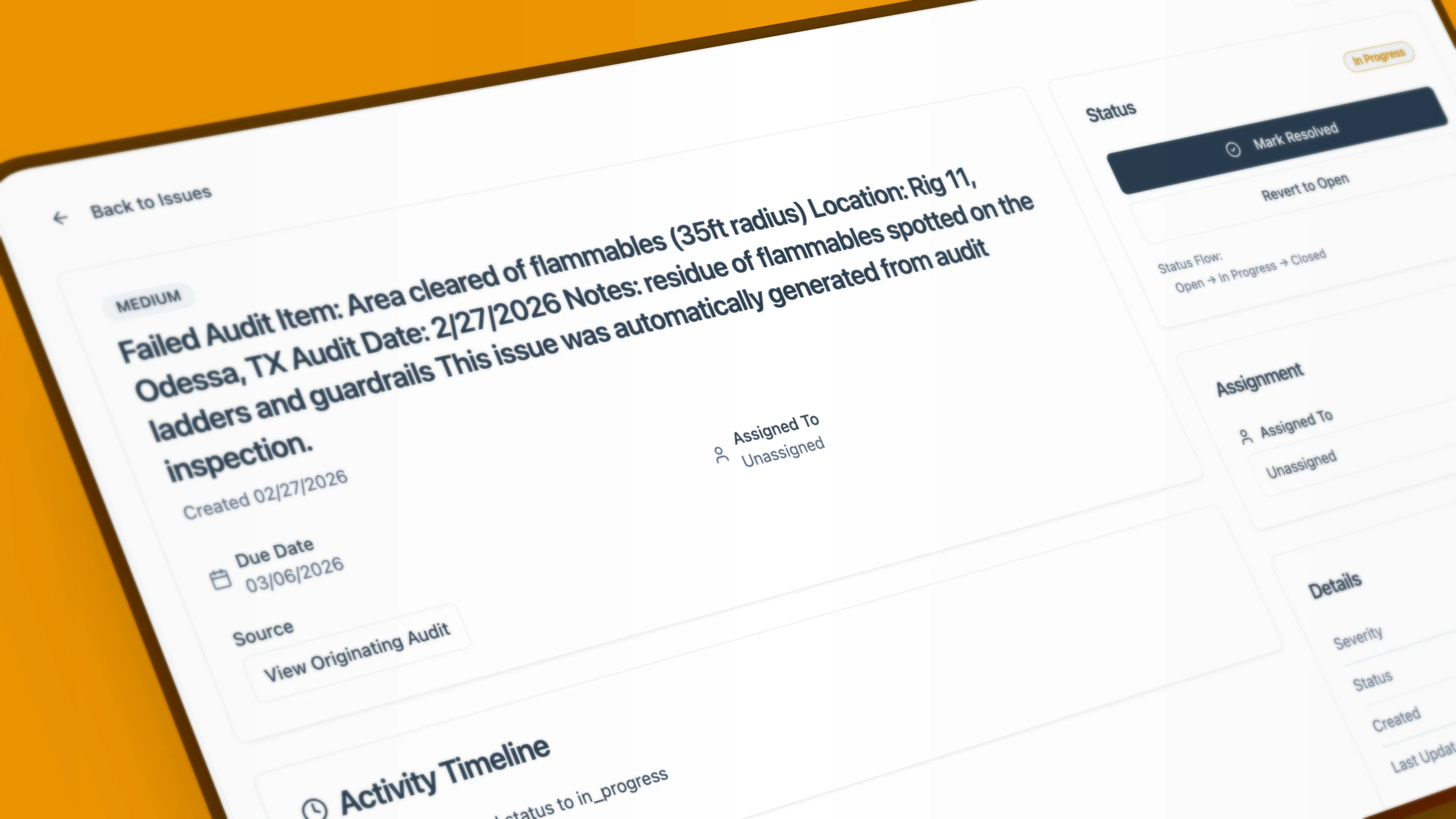
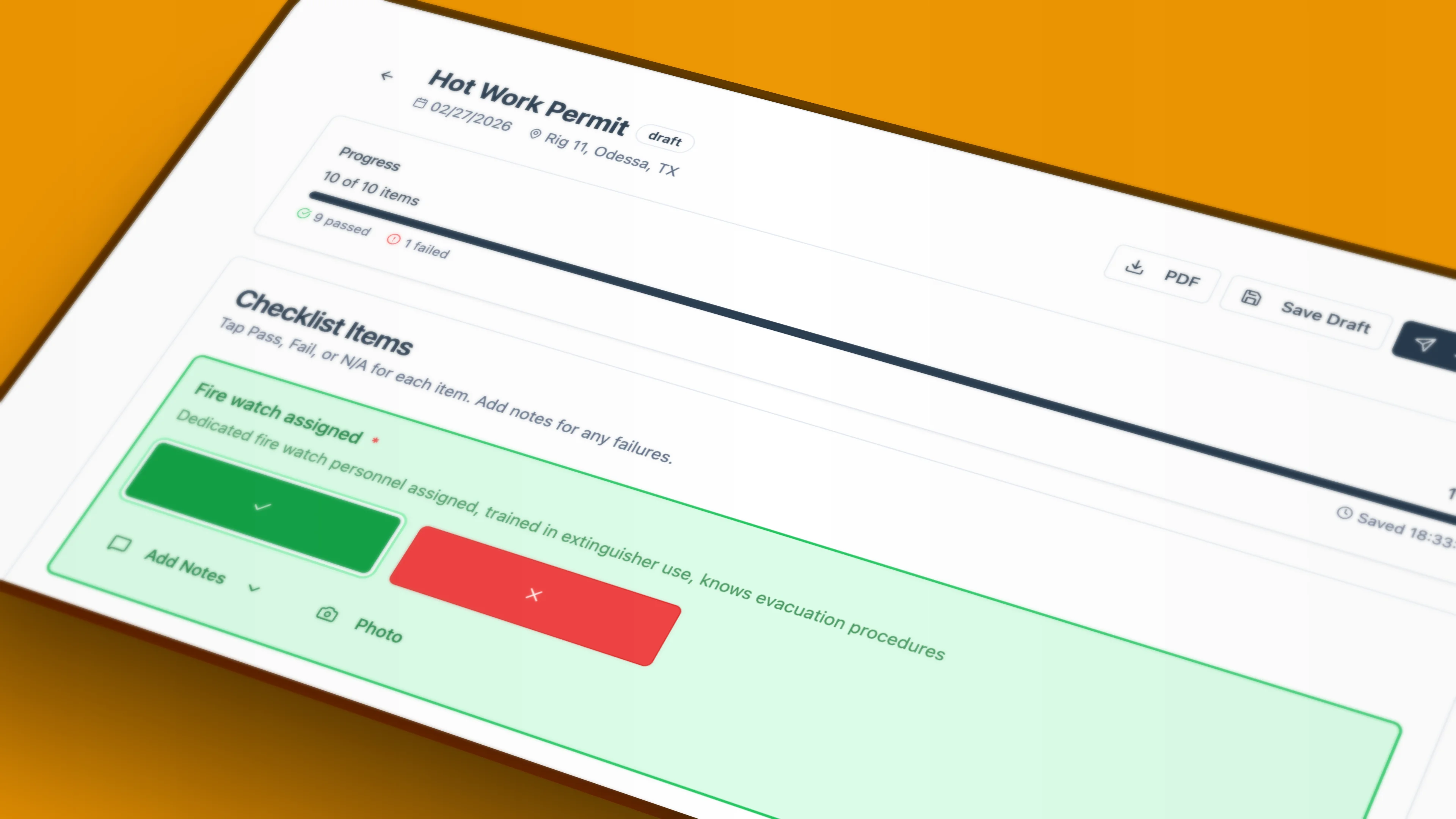
Real BasinCheck product views
See the contractor workflow before you book a demo
These are BasinCheck product screens. They show the safety dashboard, an issue record, and a hot-work permit view so evaluators can assess the product's operating model, not a marketing claim.
Live-demo script
Eight tests that expose the difference between a demo and a working system
Send these to every vendor before the meeting. They force an evaluation around a real contractor workflow, accountable follow-up, and retrievable proof rather than a polished template gallery.
Field completion under weak connectivity
Begin a real JSA, vehicle inspection, or permit with airplane mode enabled. Capture a photo and signature, finish it, reconnect, and show the final record.
Corrective action with accountability
Create a failed finding, assign a responsible person and due date, attach evidence, request review, and show what prevents an unsupported closeout.
Supervisor work queue
Show open and overdue work by crew, customer, location, owner, and severity. Ask how a supervisor follows up without managing a separate spreadsheet.
Evidence package for an evaluator
Export a completed record with timestamps, attachments, signatures, status history, and action records. Confirm how it can be retrieved months later.
One required form, configured live
Use a current field form rather than a generic template. Add conditional questions, required evidence, an approval step, and the exact language your customer expects.
Permission and change control
Demonstrate what a worker, supervisor, safety manager, and administrator can each see or alter. Then show the audit history for a configuration change.
Commercial comparison on equal scope
Request a written quote for the same people, locations, support, data migration, integrations, storage, onboarding, renewal terms, and implementation services.
Exit and record ownership
Ask how you export records, attachments, templates, action history, and user data if you change systems. Require a sample export and the policy in writing.
Use one scorecard for all three products.
Record pass, partial, or cannot demonstrate for each test. Capture the named module, plan, configuration assumption, and any professional-services dependency. That is more decision-useful than an aggregate star rating.
Bottom line
Make the choice at the level of your operating model.
SafetyCulture
The strongest first conversation when a frontline operations platform and practical inspection-to-action workflow are central.
VelocityEHS
The strongest first conversation when a unified enterprise EHS suite, broader program scope, and centralized reporting are central.
BasinCheck
The relevant additional option when an oilfield contractor needs focused field safety records and proof of completion without starting from a broad suite.
The recommendation is not to choose from this page. Use it to run a defensible evaluation, with your forms, field conditions, records, people, and commercial terms in view.
Evaluating for an oilfield contractor? Run the same eight tests on BasinCheck.
Frequently Asked Questions
Source register
First-party sources reviewed for this page
BasinCheck is not affiliated with SafetyCulture or VelocityEHS. Links open the source pages used for the factual vendor statements above. Product capabilities, plans, prices, and implementation terms can change. Confirm the requirements that matter to your team in writing.
SC-1
SafetyCulture inspections and reportsDocuments mobile and offline inspection access, image and video capture, signatures, and approvals.
SC-2
SafetyCulture tasks and actionsDocuments task assignment, inspection-linked actions, status tracking, and corrective actions.
SC-3
SafetyCulture platform overviewDescribes the vendor's broader frontline operations platform scope.
SC-4
SafetyCulture annual billing FAQLists Premium Full at $24 per user per month when billed annually at the time of review.
VE-1
VelocityEHS Accelerate PlatformDescribes a unified platform spanning Safety, Chemical Management, Ergonomics, Operational Risk, Contractor Safety, Environmental Compliance, and ESG.
VE-2
VelocityEHS InspectionsDescribes inspection scheduling, custom checklists, offline mobile completion, integrated corrective actions, and flexible reporting.
VE-3
VelocityEHS Incident ManagementDescribes incident capture and investigation, corrective actions, OSHA recordkeeping, and AI-assisted analysis on the Accelerate Platform.
VE-4
VelocityEHS Contractor SafetyDescribes contractor qualification, document review, compliance visibility, and a self-serve contractor portal before workers reach a site.