
ISNetworld compliance costs contractors more than the $875/year subscription fee. The real cost is the administrative burden: maintaining OSHA 300 logs with accurate TRIR and DART rates (30–50% of your ISNetworld grade), keeping 10–30 written safety programs updated for RAVS review (30–40% of your grade), responding to 2,000+ Management Safety Questionnaire questions, and managing insurance documentation and training records across every hiring client's unique requirements. For the safety manager at a 50-person oilfield contractor, ISNetworld compliance can consume 10–20 hours per month of administrative work that doesn't directly improve safety outcomes.
No software tool integrates directly with ISNetworld — there's no API, no automatic data sync, no magic button that populates your ISNetworld account. But the right safety software can dramatically reduce the manual work by generating the documentation ISNetworld requires: OSHA-compliant 300 logs with calculated TRIR/DART rates, incident reports classified by OSHA category, inspection records that demonstrate safety program execution, and audit trail documentation for RAVS submissions. The software handles the data; you handle the upload.
We evaluated each tool below on a specific question: How much of the ISNetworld compliance documentation burden does this software actually reduce? Here's what we found, ranked by ISNetworld-specific value for oilfield contractors.
| # | Product | Best for | Pricing |
|---|---|---|---|
| 1 | BasinCheck | Oilfield contractors (20–300 personnel) who need the most comprehensive ISNetworld compliance documentation support at flat pricing — OSHA logs, incident classification, and ISNetworld-specific tools in one platform | From $149/mo (flat team pricing — Starter: $149, Standard: $299, Pro: $599, Enterprise: $1,200+; no per-user fees) |
| 2 | VelocityEHS | Large contractors and enterprises (500+ employees) that need comprehensive OSHA recordkeeping alongside full EHS management — ISNetworld compliance documentation as part of a broader safety platform | Custom enterprise pricing (typically $15,000–$50,000+/year depending on modules and user count); demo required |
| 3 | Veriforce | Pipeline contractors who need OQ (Operator Qualification) compliance alongside ISNetworld — Veriforce documentation overlaps substantially with ISNetworld requirements | Annual subscription starting around $1,500/year; tiered by employee count and service level; quotes required |
| 4 | SafetyCulture | Contractors who need to generate inspection-based evidence for ISNetworld RAVS submissions — best for the safety program documentation component of the ISNetworld grade | Free plan available; Premium from $24/seat/month (billed annually); Enterprise pricing custom |
| 5 | Benchmark Gensuite | Large enterprises (500+ employees) that need comprehensive EHS documentation including OSHA recordkeeping for ISNetworld — best for organizations with dedicated compliance teams | Custom enterprise pricing (typically $20,000–$75,000+/year depending on modules, sites, and user count); demo required |
BasinCheck
Purpose-built oilfield safety platform with OSHA 300 auto-generation, AI incident classification, and ISNetworld Score Simulator

Best For
Oilfield contractors (20–300 personnel) who need the most comprehensive ISNetworld compliance documentation support at flat pricing — OSHA logs, incident classification, and ISNetworld-specific tools in one platform
Pricing
From $149/mo (flat team pricing — Starter: $149, Standard: $299, Pro: $599, Enterprise: $1,200+; no per-user fees)
BasinCheck is the most ISNetworld-relevant platform on this list because it was built for the exact contractor segment ISNetworld serves most heavily: oilfield service companies with 20–300 personnel managing compliance across multiple hiring clients. The platform addresses the two highest-weighted components of the ISNetworld grade — TRIR/DART rates (30–50% of the grade) through automated OSHA 300/300A generation from incident data, and RAVS documentation (30–40%) through inspection and audit trail records that demonstrate safety program execution.
The AI-powered incident classification is the feature most directly relevant to ISNetworld scoring. When a safety manager logs an incident, BasinCheck's AI suggests the OSHA classification — recordable, first aid, lost time, restricted duty — based on the incident details. This matters because incorrect classification directly impacts your TRIR calculation, which is the single most influential metric in ISNetworld scoring. A recordable classified as first aid inflates your TRIR when ISNetworld recalculates; a first aid classified as recordable deflates your score unnecessarily. Getting classification right the first time keeps your ISNetworld grade accurate.
The ISNetworld Score Simulator is a unique tool that no other platform offers. It helps contractors understand how the ISNetworld grading components work together — how a TRIR change affects the overall grade, how RAVS improvements translate to scoring changes — so they can prioritize compliance efforts on the components with the highest grade impact. Combined with flat pricing that doesn't scale per-user, BasinCheck provides the most ISNetworld-focused value for oilfield contractors at the most predictable cost.
Key Features
Pros
- The only platform on this list built specifically for oilfield contractors managing ISNetworld compliance — the ISNetworld Score Simulator, OSHA 300 auto-generation, and AI incident classification address the highest-weighted components of the ISNetworld grade directly
- AI incident classification reduces the most error-prone step in OSHA recordkeeping — incorrect classification (calling a recordable "first aid" or vice versa) directly impacts TRIR calculations, which is 30% of the ISNetworld grade
- Flat pricing means your ISNetworld compliance software cost is predictable — no per-user fees when you add seasonal workers or crew rotations that are common in oilfield operations
Cons
- Purpose-built for oil and gas — contractors in construction, manufacturing, or general industry will find the platform less tailored to their ISNetworld use cases
- Doesn't manage ISNetworld submissions directly — generates the documentation (OSHA logs, inspection records, incident reports) that you then upload to ISNetworld; the manual upload step remains
- Smaller vendor compared to VelocityEHS or Benchmark Gensuite — fewer third-party integrations with payroll or HR systems that large contractors may use for hours-worked data
Verdict: The best ISNetworld compliance tool for oilfield contractors. OSHA 300 auto-generation, AI incident classification, and the ISNetworld Score Simulator directly address the highest-weighted ISNetworld grade components — all at flat pricing.
VelocityEHS
Enterprise EHS platform with comprehensive OSHA recordkeeping and safety statistics that feed ISNetworld documentation requirements
Best For
Large contractors and enterprises (500+ employees) that need comprehensive OSHA recordkeeping alongside full EHS management — ISNetworld compliance documentation as part of a broader safety platform
Pricing
Custom enterprise pricing (typically $15,000–$50,000+/year depending on modules and user count); demo required
VelocityEHS provides the most comprehensive OSHA recordkeeping module on this list, which makes it effective for ISNetworld compliance documentation even though it wasn't built with ISNetworld specifically in mind. The OSHA 300/300A generation with automated TRIR and DART rate calculations directly addresses the highest-weighted component of the ISNetworld grade. For large contractors managing hundreds of incidents across multiple sites, the automated rate calculations and multi-year trending ensure that ISNetworld TRIR submissions are accurate and current without manual spreadsheet work.
The multi-site benchmarking capability is particularly relevant for large contractors with ISNetworld. Because ISNetworld grades are based on company-wide safety statistics, a single high-incident site can drag down the aggregate TRIR and DART rates that affect the ISNetworld grade. VelocityEHS's benchmarking dashboards help safety directors identify outlier sites, target improvement efforts, and monitor how site-level changes affect the company-wide rates that ISNetworld evaluates.
The limitation for ISNetworld purposes is the enterprise-first positioning. VelocityEHS doesn't include ISNetworld-specific features — there's no grade simulation, no MSQ guidance, no RAVS document alignment tool. It generates excellent OSHA documentation that supports ISNetworld compliance, but the contractor still needs to understand ISNetworld's grading methodology and manage the upload process. For large contractors with dedicated compliance teams who can bridge that gap, VelocityEHS provides the best data foundation. For smaller contractors who need more ISNetworld-specific guidance, other tools are more practical.
Key Features
Pros
- The most comprehensive OSHA recordkeeping module on this list — 300/300A generation, rate calculations, classification workflows, and multi-year trending all in one system; this addresses the single most influential ISNetworld grade component (TRIR/DART)
- Multi-site safety performance benchmarking helps large contractors identify which locations are dragging down their aggregate TRIR — ISNetworld uses company-wide rates, so one high-incident site affects the entire grade
- Training management module generates the documentation that supports ISNetworld MSQ responses about employee training, qualifications, and competency verification
Cons
- Enterprise pricing is prohibitive for the small and mid-size oilfield contractors who represent the majority of ISNetworld users — $15,000+/year minimum before implementation costs, which dwarfs the ISNetworld subscription itself
- No ISNetworld-specific features or tools — OSHA recordkeeping and safety documentation are excellent, but there's no ISNetworld grade monitoring, score simulation, or MSQ-focused functionality
- Implementation timeline of 3–6 months means you won't see ISNetworld compliance benefits quickly — if your ISN grade is at risk now, VelocityEHS is a long-term investment, not an immediate fix
- Overkill for contractors whose primary need is ISNetworld documentation — the platform includes environmental, industrial hygiene, and sustainability modules you may never use
Verdict: The strongest OSHA recordkeeping platform available — excellent for generating ISNetworld documentation at scale. Best for large enterprises with compliance teams; smaller contractors will find it overpriced and over-complex for their ISNetworld needs.
Veriforce
Contractor prequalification network with OQ compliance, safety training, and documentation that overlaps ISNetworld requirements

Best For
Pipeline contractors who need OQ (Operator Qualification) compliance alongside ISNetworld — Veriforce documentation overlaps substantially with ISNetworld requirements
Pricing
Annual subscription starting around $1,500/year; tiered by employee count and service level; quotes required
Veriforce occupies a unique position on this list: it's not an ISNetworld management tool, but a parallel prequalification network whose documentation requirements overlap substantially with ISNetworld's. For pipeline contractors — the segment where Veriforce has the deepest penetration — maintaining Veriforce compliance means a significant portion of your ISNetworld documentation is already prepared. Safety training records, OQ certifications, worker competency verification, and safety program documentation all map to ISNetworld RAVS and MSQ requirements.
The training library is particularly valuable for ISNetworld compliance. Veriforce's 175+ courses generate certificates and completion records that directly support ISNetworld MSQ responses about employee training and competency. Instead of creating separate training documentation for ISNetworld, contractors can upload Veriforce training records as evidence. The free monthly safety meetings add ongoing documentation — each meeting generates certificates that demonstrate continuous safety education, which ISNetworld values in both RAVS and MSQ scoring.
The critical gap is OSHA recordkeeping. Veriforce doesn't generate OSHA 300 logs, calculate TRIR/DART rates, or manage incident classification — the components that account for 30–50% of the ISNetworld grade. Contractors using Veriforce still need a separate tool for OSHA compliance documentation. Combined with the $1,500+/year subscription on top of ISNetworld's $875+ fee, the total prequalification cost is significant. Veriforce is most practical for pipeline contractors who need OQ compliance anyway — the ISNetworld documentation overlap is a bonus, not the primary value proposition.
Key Features
Pros
- For pipeline contractors, Veriforce compliance documentation overlaps 60–70% with ISNetworld requirements — maintaining Veriforce compliance means a large portion of your ISNetworld documentation is already prepared
- The 175+ training course library directly generates documentation that ISNetworld requires for MSQ training questions — certificates, completion records, and competency verification are already formatted for compliance uploads
- Deep oil and gas specialization — Veriforce understands the specific documentation needs of oilfield contractors, which translates to more ISNetworld-relevant evidence generation than generic EHS platforms
Cons
- Veriforce is a parallel prequalification network, not an ISNetworld management tool — it generates overlapping documentation, but you still manage two separate platforms with separate submissions and separate fees
- No OSHA 300 log generation and no TRIR/DART rate calculation — the highest-weighted ISNetworld grade component (TRIR/DART, 30–50%) is not addressed; you need a separate tool for OSHA recordkeeping
- Customer support is widely criticized — users report callbacks 1 in 10 times, messages unanswered for 2+ weeks, and billing disputes that take months to resolve
- Pricing adds up when combined with ISNetworld subscription ($875+/year) — Veriforce ($1,500+/year) plus ISNetworld creates a $2,400+ annual prequalification cost before any EHS software
Verdict: Best for pipeline contractors who need OQ compliance and want ISNetworld documentation overlap. The training library and OQ records support ISNetworld submissions, but you still need a separate tool for OSHA logs and TRIR calculations.
Try BasinCheck Free for 7 Days
Check BasinCheck plan limits and pricing against your requirements.
Start Free TrialSafetyCulture
Mobile inspection platform that generates audit trail documentation supporting ISNetworld RAVS and safety program evidence
Best For
Contractors who need to generate inspection-based evidence for ISNetworld RAVS submissions — best for the safety program documentation component of the ISNetworld grade
Pricing
Free plan available; Premium from $24/seat/month (billed annually); Enterprise pricing custom
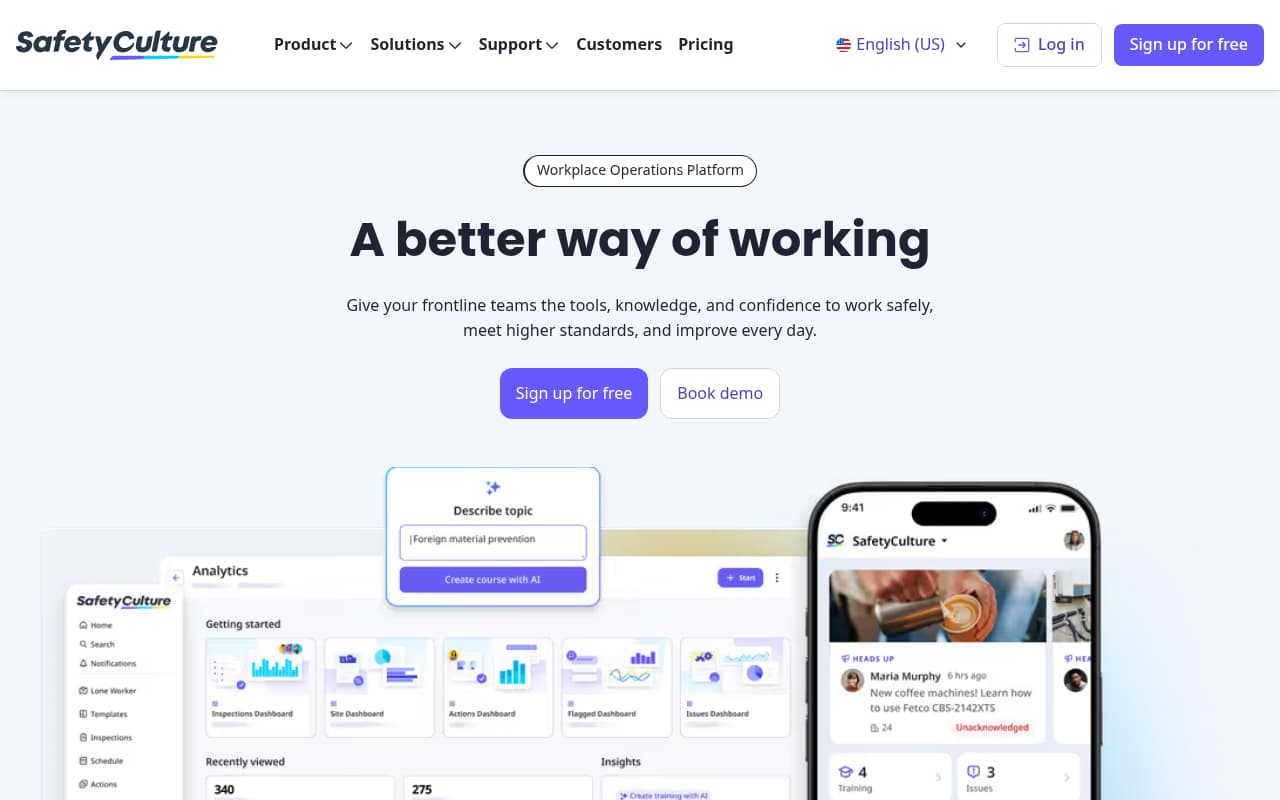
SafetyCulture's value for ISNetworld compliance is focused on one component: RAVS documentation. ISNetworld's RAVS (Review and Verification Services) evaluates contractors' written safety programs, and one of the strongest evidence types is proof of program execution — documented inspections with photos, timestamps, and signatures showing that safety procedures are actually followed in the field, not just written in a manual. SafetyCulture excels at generating this evidence. Every inspection produces a formatted PDF report with GPS-tagged photos, digital signatures, and corrective action records that can be uploaded to ISNetworld as supporting documentation.
The template library is genuinely useful for ISNetworld RAVS preparation. Contractors can find or build inspection templates that map to each safety program ISNetworld evaluates — fall protection, confined space entry, hot work permits, lockout/tagout, and similar. Running these inspections regularly in SafetyCulture generates a documented evidence trail that ISNetworld reviewers value. The corrective action tracking adds another layer: demonstrating that inspection findings lead to documented corrective actions shows active safety management, not just compliance paperwork.
The gap is significant: SafetyCulture addresses RAVS evidence (30–40% of the ISNetworld grade) but provides nothing for TRIR/DART tracking (30–50%), OSHA log generation, incident classification, or MSQ management. For contractors whose ISNetworld grade is primarily limited by RAVS scores, SafetyCulture is a practical evidence generator. For contractors struggling with TRIR or OSHA recordkeeping — the higher-weighted components — SafetyCulture doesn't address the core problem.
Key Features
Pros
- Inspection evidence is the most practical tool for ISNetworld RAVS submissions — GPS-tagged photos, timestamps, and digital signatures prove safety program execution, which is 30–40% of the ISNetworld grade
- Free plan provides an accessible entry point for small contractors starting ISNetworld compliance — basic inspection capability generates evidence without financial commitment
- The largest inspection template library available — 100,000+ pre-built templates means you can find industry-relevant checklists quickly and customize them for your hiring clients' specific ISNetworld requirements
Cons
- No OSHA 300 log generation, no TRIR/DART rate calculation, no incident classification — the highest-weighted ISNetworld component (TRIR/DART, 30–50% of grade) is not addressed at all
- Per-user pricing becomes expensive for oilfield crews — a 30-person crew at $24/seat/month is $720/month ($8,640/year) on top of the ISNetworld subscription, making total compliance costs substantial
- Generic across industries — no ISNetworld-specific features, no MSQ guidance, no RAVS alignment tools; you use it as a general inspection tool and manually connect outputs to ISNetworld requirements
- Offline mode is limited to previously downloaded templates — field inspections in areas without cell service (common in oilfield operations) may encounter sync issues with photos and data
Verdict: The best inspection evidence generator for ISNetworld RAVS submissions. If your ISNetworld grade is limited by safety program documentation, SafetyCulture produces the evidence you need — but it won't help with TRIR/DART calculations or OSHA recordkeeping.
Benchmark Gensuite
Enterprise EHS suite with OSHA recordkeeping, contractor management, and comprehensive safety documentation for ISNetworld
Best For
Large enterprises (500+ employees) that need comprehensive EHS documentation including OSHA recordkeeping for ISNetworld — best for organizations with dedicated compliance teams
Pricing
Custom enterprise pricing (typically $20,000–$75,000+/year depending on modules, sites, and user count); demo required
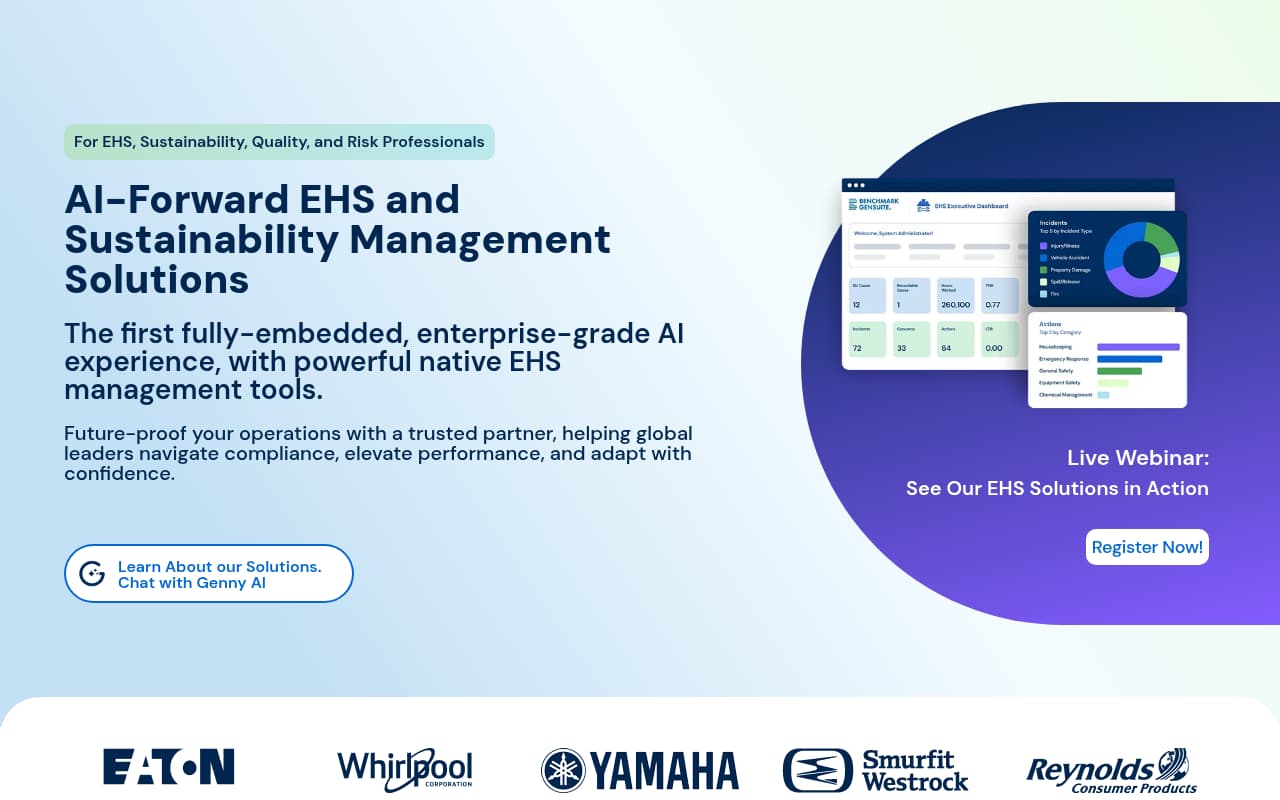
Benchmark Gensuite addresses the broadest range of ISNetworld documentation requirements on this list, but at an enterprise price point. The OSHA injury and illness recordkeeping module generates the data that feeds ISNetworld's highest-weighted grade component (TRIR/DART rates). The incident management module handles classification and investigation workflows that produce documentation for both OSHA compliance and ISNetworld evidence. Inspection, audit, corrective action, and training modules generate the documentation trail that supports RAVS submissions and MSQ responses.
For large enterprises with dedicated compliance teams, the cross-module integration is the value proposition. Instead of managing OSHA recordkeeping in one tool, inspections in another, and training in a third, Gensuite consolidates all compliance documentation in a single system. Every incident, inspection, corrective action, and training record exists in one database, with one audit trail, exportable in formats that support both OSHA audits and ISNetworld submissions. The AI-generated contractor firm summaries add a layer of compliance visibility that helps enterprise buyers monitor their own prequalification status across modules.
The barrier is clear: cost and complexity. Benchmark Gensuite is practical for organizations with 500+ employees, $20,000+ annual software budgets, and dedicated EHS teams who can manage the implementation and ongoing administration. For the 20–300 person oilfield contractors who represent the bulk of ISNetworld users, the platform is dramatically overpriced and over-engineered for the core need of generating ISNetworld compliance documentation. The ROI calculation only works at enterprise scale.
Key Features
Pros
- The most comprehensive documentation generation across ISNetworld requirements — OSHA recordkeeping, incident management, inspection records, corrective actions, training documentation, and contractor management all in one system
- OSHA injury and illness recordkeeping module is purpose-built for compliance — data tracking aligns with OSHA 300/300A requirements that feed ISNetworld TRIR/DART scoring
- Enterprise-grade audit trail documentation supports both ISNetworld RAVS submissions and direct OSHA audit readiness — dual-purpose compliance documentation from a single platform
Cons
- The most expensive option on this list by a wide margin — $20,000+/year starting price plus implementation costs means the software alone costs more than 15 years of ISNetworld subscriptions; only makes sense for organizations with 500+ employees
- No ISNetworld-specific features — no grade tracking, no MSQ management, no RAVS alignment tools; you use the general EHS capabilities to generate ISNetworld-relevant documentation
- Implementation takes 3–9 months with dedicated admin resources — not a solution for contractors with immediate ISNetworld compliance pressure
- Designed for large enterprises, not oilfield contractors — the platform lacks industry-specific features for oil and gas operations and requires significant customization for oilfield workflows
Verdict: The broadest ISNetworld documentation coverage from a single platform — but at enterprise pricing that only makes sense for large organizations. Small and mid-size oilfield contractors will find more ISNetworld-relevant value at lower cost elsewhere.
Side-by-side feature comparison
| Software | Best For | Starting Price | OSHA 300 Generation | TRIR/DART Calculation | RAVS Documentation | ISN-Specific Tools | Oilfield Focus |
|---|---|---|---|---|---|---|---|
| BasinCheck | O&G contractors (20–300) | $149/mo (flat) | Yes (auto from incidents) | Yes (auto + AI classification) | Yes (inspections + audits) | Yes (Score Simulator) | Yes (purpose-built) |
| VelocityEHS | Large enterprises (500+) | ~$15,000/year | Yes (comprehensive) | Yes (auto + multi-site) | Yes (audits + inspections) | No | No (general EHS) |
| Veriforce | Pipeline contractors | ~$1,500/year | No | No | Partial (training docs) | No | Yes (pipeline-focused) |
| SafetyCulture | Inspection evidence | Free / $24/seat/mo | No | No | Yes (inspection evidence) | No | No (cross-industry) |
| Benchmark Gensuite | Large enterprises (500+) | ~$20,000/year | Yes (OSHA module) | Yes | Yes (comprehensive) | No | No (general EHS) |
How we evaluated these tools
We evaluated 10+ safety and EHS platforms specifically on their ability to reduce the ISNetworld compliance documentation burden for contractors. Our assessment focused on five criteria aligned with ISNetworld's grading components:
- OSHA 300/300A generation (TRIR/DART support): Does the platform auto-generate OSHA 300 logs from incident data? Does it calculate TRIR and DART rates automatically? This addresses the highest-weighted ISNetworld component (30–50% of the grade). Platforms that automate OSHA recordkeeping provide the most ISNetworld-relevant value.
- RAVS documentation support: Does the platform generate the inspection records, audit trails, and safety program evidence that ISNetworld's RAVS reviewers evaluate? RAVS accounts for 30–40% of the ISNetworld grade, making documentation quality critical.
- ISNetworld-specific features: Does the platform include any ISNetworld-specific tools — grade simulation, MSQ guidance, RAVS alignment tools, or ISNetworld score tracking? Only one platform on this list offers ISNetworld-specific functionality; most generate general compliance documentation that supports ISNetworld submissions indirectly.
- Pricing relative to ISNetworld ROI: Is the software cost proportional to the ISNetworld compliance value it provides? For small and mid-size oilfield contractors — the primary ISNetworld users — a $50,000/year enterprise EHS platform may not be justifiable even if it generates excellent OSHA documentation. We considered cost-effectiveness relative to contractor size.
- Oilfield contractor fit: Is the platform designed for or adaptable to the oilfield contractor workflows that ISNetworld most heavily serves? Oil and gas contractors face unique challenges — remote locations, variable crew sizes, multiple hiring clients with different ISNetworld requirements — that generic EHS platforms may not address.
BasinCheck is our product. We ranked ourselves at #1 because we're the only platform on this list purpose-built for oilfield contractors with ISNetworld-specific tools (the Score Simulator), automated OSHA 300 generation, and AI incident classification — all at flat pricing. We're transparent about our limitations: we don't offer the enterprise-scale OSHA recordkeeping depth of VelocityEHS or the training library breadth of Veriforce.
Frequently Asked Questions
What determines my ISNetworld grade?
ISNetworld grades (A through F) are based on weighted components: TRIR and DART safety rates (30–50% weight, calculated from your OSHA logs and compared to NAICS industry averages), RAVS review of written safety programs (30–40%, scored by ISNetworld reviewers against each hiring client's criteria), Management Safety Questionnaire responses (10–15%, based on completeness and accuracy of 2,000+ questions), and insurance verification (pass/fail). Each hiring client can set different requirements and weights, so your grade may vary across clients.
Can any software integrate directly with ISNetworld?
No. As of 2026, ISNetworld does not offer a public API for third-party data integration. No software tool can automatically populate your ISNetworld account. What safety software can do is generate the documentation ISNetworld requires — OSHA 300 logs, incident reports, inspection records, training certificates — so your ISNetworld submissions are accurate and current. The manual upload step to ISNetworld remains regardless of which tool you use.
How does TRIR affect my ISNetworld score?
TRIR (Total Recordable Incident Rate) is typically the single most influential metric in ISNetworld scoring, accounting for 30% or more of the total grade. ISNetworld compares your 3-year rolling TRIR against the industry average for your NAICS code. A TRIR below the industry average improves your grade; above the average drops it. A single work-related fatality can cost 10 points, and an associated OSHA citation can reduce the score by another 25 points. Maintaining accurate OSHA 300 logs with correct incident classification is essential because TRIR is calculated directly from that data.
What safety programs does ISNetworld RAVS review?
RAVS (Review and Verification Services) typically reviews 10–30 written safety programs depending on the hiring client's requirements. Common programs include: fire safety, fall protection, confined space entry, lockout/tagout, electrical safety, hazard communication, respiratory protection, PPE, hot work permits, hydrogen sulfide (H2S) for oilfield, emergency action plans, and incident investigation procedures. Each program is reviewed against the specific hiring client's criteria — not a standard checklist — so the same program might score differently across clients.
How quickly can software improve my ISNetworld grade?
Software doesn't improve your ISNetworld grade directly — it generates better documentation that supports a higher grade over time. TRIR improvements take 1–3 years to fully reflect because ISNetworld uses a 3-year rolling average. RAVS improvements can reflect within 1–3 months after resubmitting updated safety programs. MSQ score improvements can be immediate after correcting responses. The fastest impact typically comes from correcting MSQ errors and resubmitting RAVS documentation with better evidence — areas where software-generated inspection records and incident reports make the biggest difference.
Final verdict
ISNetworld compliance is ultimately a documentation challenge: the contractors with the best grades aren't necessarily the safest — they're the ones with the most accurate, complete, and current documentation. Software won't fix a genuine safety problem, but it eliminates the administrative gap between "doing safety well" and "proving you do safety well" that ISNetworld measures.
For oilfield contractors (20–300 personnel) who need the most ISNetworld-specific value, BasinCheck provides OSHA 300 auto-generation, AI incident classification, and the ISNetworld Score Simulator at flat pricing — directly addressing the highest-weighted grade components. For large enterprises with dedicated compliance teams, VelocityEHS offers the deepest OSHA recordkeeping module. For pipeline contractors who already need OQ compliance, Veriforce generates overlapping documentation. For teams focused on inspection evidence for RAVS, SafetyCulture produces the strongest audit trail. And for large enterprises wanting consolidated EHS documentation, Benchmark Gensuite covers the broadest range at enterprise pricing.
Start with the ISNetworld grade component that's dragging your score down most. If it's TRIR/DART — invest in OSHA recordkeeping automation. If it's RAVS — invest in inspection evidence generation. If it's MSQ — review your responses for accuracy before investing in new software. The most cost-effective ISNetworld improvement is often fixing what's already documented incorrectly, not adding new tools to an already complex compliance stack.